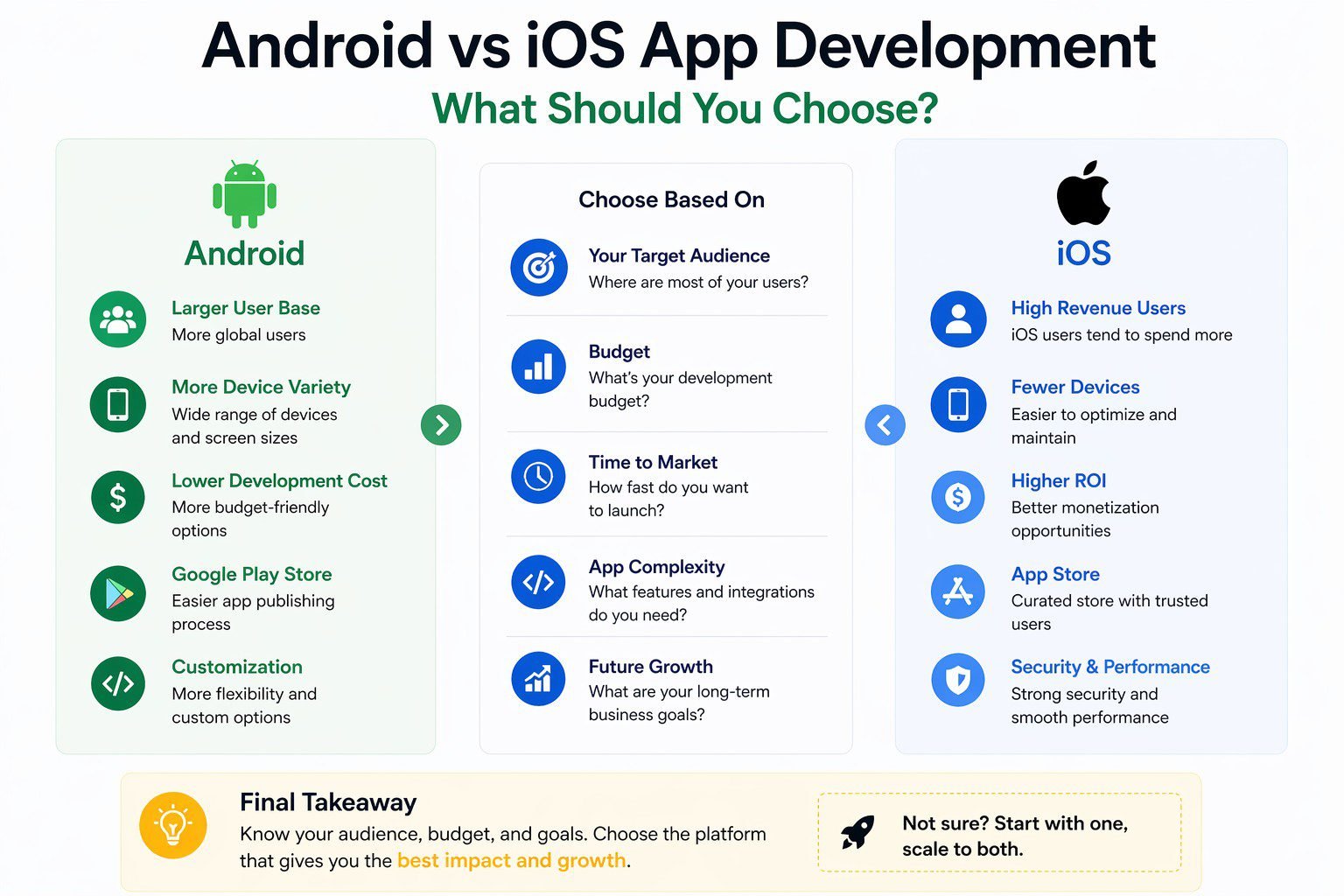
Android vs iOS app development still feels like a defining decision for businesses in 2026. The confusion has not disappeared, it has simply evolved with changing user expectations and platform capabilities. Today, the choice is not just technical, it directly impacts growth, revenue, and long term scalability.
Many founders either rush based on trends or delay due to uncertainty. Both paths lead to inefficiencies. A clear understanding of both ecosystems helps you move forward with confidence and avoid unnecessary setbacks.
- Android provides wider reach and faster user acquisition
- iOS delivers stronger revenue potential and premium audience
- Android development requires handling multiple device variations
- iOS ensures stable and predictable performance
- A phased launch strategy often works better than dual platform release
Table of Contents
- Understanding the Two Ecosystems
- Market Share vs User Behavior
- Development Cost and Time Reality
- Performance and User Experience
- Revenue and Monetization Trends
- Real World Scenario
- Success Story
- User Reviews
- Forum Discussions
- Decision Framework
- FAQs
- Conclusion
Understanding the Two Ecosystems
Android offers flexibility through an open ecosystem that supports a wide range of devices. Developers can experiment more freely, but they must manage multiple configurations and hardware variations. This flexibility increases reach, yet it also introduces technical complexity.
iOS follows a controlled ecosystem with strict development guidelines. This results in consistent performance and predictable behavior across devices. Developers often find it easier to maintain quality on iOS because fewer variations exist.
Market Share vs User Behavior
Android dominates global market share, especially in regions where affordability drives adoption. This makes it a strong choice for businesses aiming to scale quickly and reach a broader audience.
However, iOS users tend to spend more within apps. This trend continues in 2026, particularly for subscription based services and premium products. Businesses targeting higher value users often see better returns on iOS.
Development Cost and Time Reality
Android app development cost can increase due to device fragmentation. Testing across different screen sizes and hardware configurations requires additional time and resources. Without proper planning, this can extend timelines.
iOS development benefits from a streamlined environment. Fewer devices lead to faster testing cycles and fewer unexpected issues. This often results in more predictable development timelines.
Performance and User Experience
iOS delivers consistent performance due to tight integration between hardware and software. Apps tend to run smoothly, which improves overall user satisfaction. This becomes important for apps that rely on speed and responsiveness.
Android provides flexibility but performance may vary depending on device quality. Developers need to optimize apps carefully across different configurations. User expectations also differ, with Android users valuing customization.
Revenue and Monetization Trends
iOS performs strongly for in app purchases and subscription models. Users are more willing to pay for premium features and services. This makes it suitable for SaaS and content based platforms.
Android works well with ad driven monetization models. Its larger user base supports higher engagement and impressions. Many free apps succeed by leveraging this scale effectively.
Real World Scenario
A startup building a fitness app must evaluate its audience before choosing a platform. If the goal is global reach with affordable pricing, Android becomes the logical starting point. It allows faster user acquisition.
If the same app targets premium users willing to pay for coaching programs, iOS may deliver better results. The platform directly influences user behavior and expectations.
Success Story
A fintech startup in India faced this decision in 2025. They needed rapid adoption while maintaining performance and trust. Instead of launching on both platforms, they started with Android.
After gaining traction and user feedback, they expanded to iOS with a refined product. The improved version performed better, leading to higher conversions and retention rates.
For businesses navigating similar decisions, App Development Company Tech XML provides structured guidance. :contentReference[oaicite:0]{index=0} They focus on aligning platform choice with business goals rather than offering a one sided solution.
User Reviews
Rahul Mehta, Mumbai chose Android first to reach a wider audience quickly. Later, expanding to iOS improved revenue per user and overall conversions significantly.
Emily Carter, New York started with iOS because her app relied on subscriptions. This helped generate early revenue before scaling to Android for broader reach.
Arjun Singh, Delhi expected Android development to be simpler, but testing took longer than planned. Despite this, it helped him achieve strong market visibility.
Forum Discussions
Question by Vikram, Bangalore: Should I start with Android if my budget is limited?
Community Reply by Neha, Pune: It depends on your audience. Android works well for reach, but iOS may deliver better returns if your users are willing to pay.
Question by Jason, London: Is launching on both platforms at once a good idea?
Community Reply by Riya, Hyderabad: Starting with one platform allows you to test your product and refine it before expanding. This reduces risk and improves quality.
Decision Framework
If your goal is rapid growth and market reach, Android offers a clear advantage. It connects you with a larger audience and supports faster expansion.
If your focus is premium users and revenue generation, iOS becomes more suitable. It supports better monetization and consistent performance.
In many cases, a phased approach works best. Start with one platform, gather feedback, and then expand strategically. This ensures better product quality and reduced risk.
FAQs
Which platform is better for startups in 2026?
The better platform depends on your audience and business model. Android supports scale, while iOS often delivers stronger monetization through premium users.
Is Android development cheaper than iOS?
Android may appear cheaper initially, but testing across multiple devices can increase costs. iOS development remains more predictable due to fewer variations.
Can I build apps for both platforms together?
Yes, but it requires more resources and planning. Many businesses prefer starting with one platform and expanding later for better results.
Which platform generates more revenue?
iOS generally generates higher revenue per user, while Android can produce strong results through scale and advertising models.
Should I launch on both platforms at the same time?
Launching on both platforms is not always necessary. Starting with one allows better testing and refinement before expansion.
Conclusion
The Android vs iOS app development decision is less about choosing one platform over the other and more about understanding your business context. Each platform offers unique strengths, and neither is universally better in every scenario.
In 2026, successful businesses focus on alignment rather than comparison. They evaluate their audience, monetization model, and growth stage before making a choice. This approach leads to better outcomes and fewer costly mistakes.
When you approach this decision with clarity, you build a product that fits your users instead of chasing trends. That is what ultimately drives long term success.






Leave a Reply