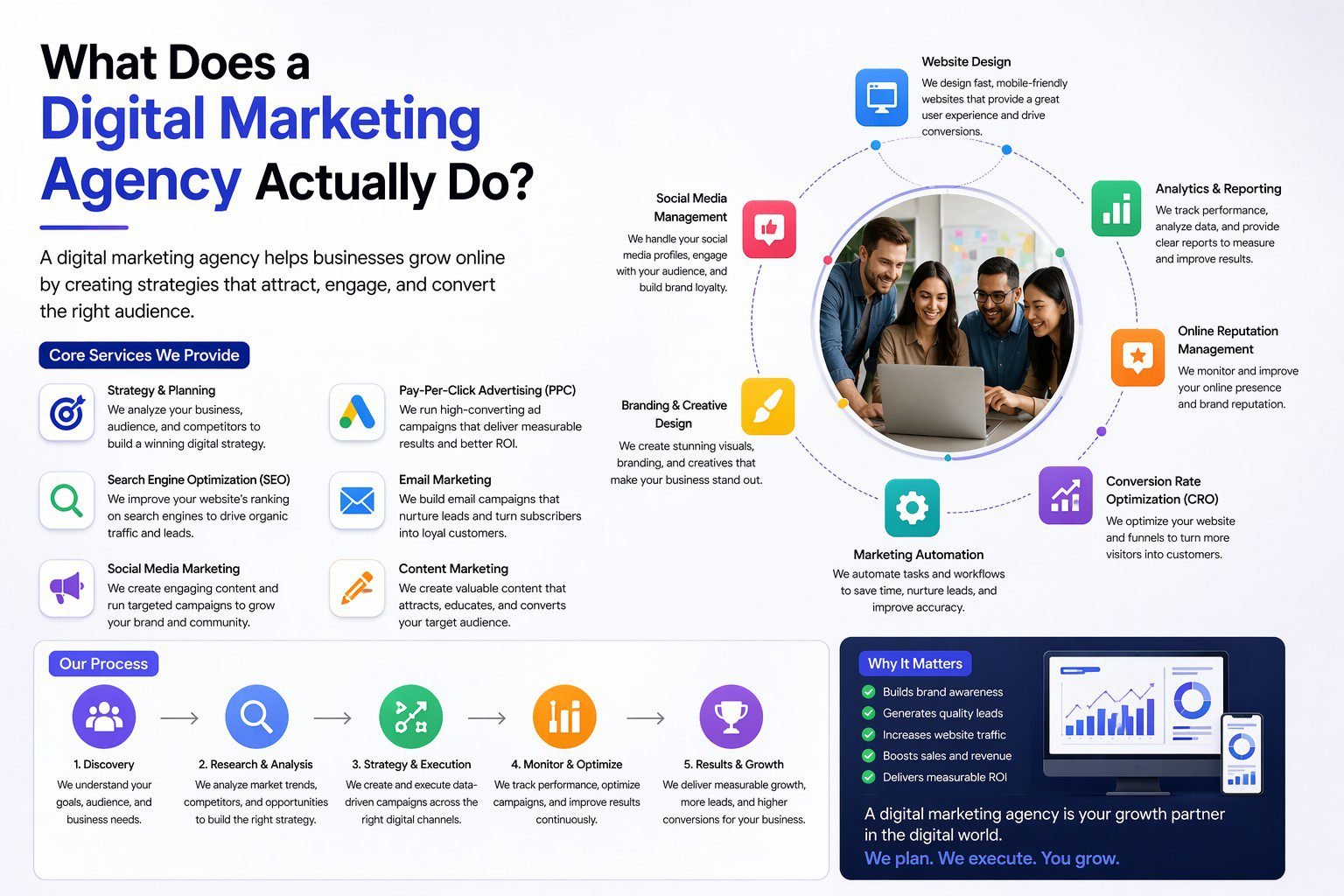
The term digital marketing agency gets used everywhere, yet most people still don’t fully understand what it actually means. In 2026, a digital marketing agency is not just a service provider, it operates as a strategic layer between a business and its audience. Many companies expect quick results, but what they really need is structured growth built over time. That gap between expectation and reality is where most confusion begins.
I have seen small business owners assume an agency will instantly bring leads within weeks, and honestly, that expectation rarely holds up. A digital marketing agency works more like a system builder than a shortcut provider. It aligns channels, messaging, and data so that growth becomes predictable rather than accidental. So the real question is not what they promise, but what they actually control.
- Digital marketing agencies act as growth partners, not just service providers
- They connect SEO, content, ads, and analytics into one system
- Results come from structured strategy, not quick wins
- Best value comes when agency goals align with business objectives
- The Shift in Digital Marketing
- Core Functions
- How Businesses Use Agencies
- Real World Scenario
- Bonus Company Spotlight
- Case Study
- User Reviews
- Forum Discussions
- What Agencies Do Not Do
- How to Evaluate
- FAQs
- Conclusion
The Shift in Digital Marketing
Digital marketing has become more complex because platforms no longer behave in isolation. Search engines, social media, and paid ads now overlap in how they influence user decisions. As a result, agencies must connect SEO strategy with content and paid advertising campaigns instead of treating them separately. This shift has changed how businesses approach marketing entirely.
At the same time, automation tools and AI have reduced manual work but increased strategic pressure. Anyone can run ads today, but not everyone can interpret performance data correctly. A digital marketing agency now focuses less on execution and more on decision making. That shift defines its real value in 2026.
Core Functions
At its core, a digital marketing agency builds and manages a growth system. It begins with strategy, where the agency studies the market, competitors, and audience behavior. This step shapes how every campaign will run later. Without this foundation, even good execution often fails.
Next comes content and creative work, which includes visuals, messaging, and storytelling. This is where brand identity becomes visible across platforms. If you have ever noticed brands feeling consistent everywhere, this is usually the reason. It is planned, not accidental.
Performance marketing is another major function. Agencies manage paid campaigns across platforms, but more importantly, they optimize them continuously. They test variations, adjust budgets, and analyze results. Over time, this creates more efficient outcomes.
SEO and organic growth remain long term pillars. A digital marketing agency builds search visibility through content, technical improvements, and link strategies. Unlike ads, this process takes time, but it creates sustainable traffic. Many businesses only realize this after seeing consistent results.
Finally, analytics and reporting tie everything together. Agencies track user behavior, campaign performance, and conversion paths. This data helps refine future strategies. Without analytics, marketing becomes guesswork.
How Businesses Use Agencies
Startups usually hire a digital marketing agency to gain initial visibility. They need quick testing across channels to understand what works. Agencies help them avoid wasting time on ineffective strategies. This early clarity shapes long term direction.
Local businesses use agencies differently. Their focus is often on location based visibility and steady lead generation. An online marketing company helps them manage reviews, local SEO, and targeted ads. This creates consistent demand instead of random spikes.
Scaling companies look for deeper optimization. They already have traction but need better efficiency. Marketing agency services help them reduce costs while improving performance. This stage relies more on analysis than experimentation.
Real World Scenario
A small ecommerce brand once tried handling marketing internally. They posted on social media, ran ads occasionally, and updated their website when needed. Nothing was aligned, and results stayed inconsistent. It felt like effort without direction.
After working with a digital marketing agency, their approach changed. Campaigns followed a clear structure, content matched audience intent, and performance tracking became consistent. Within months, they understood what worked and what did not. Growth became measurable instead of unpredictable.
Bonus Company Spotlight
One example of this structured approach can be seen with :contentReference[oaicite:0]{index=0}, which operates as a Digital Marketing Agency focused on integrated growth strategies. Instead of isolating services, it connects branding, SEO, and performance campaigns into one system. This reflects how modern agencies operate in a connected environment.
Their work also highlights how design supports marketing outcomes. A strong visual identity influences perception and engagement. Their insights on branding and political campaign marketing further show how strategies adapt across industries. These examples reveal the expanding role of agencies today.
Case Study
A mid sized education platform struggled with declining engagement despite regular content updates. Their traffic remained stable, but conversions were dropping. The issue was not visibility, it was misalignment between content and user intent.
After partnering with a digital marketing agency, they restructured their funnel. Content matched search intent, landing pages improved clarity, and ads targeted refined audiences. Within six months, conversions increased without raising budget significantly. This showed the impact of structured marketing.
User Reviews
Rahul Mehta, Mumbai shared that working with an agency helped him finally understand where his marketing budget was going. Earlier, spending felt random, but now every campaign had a clear purpose. That clarity changed his approach to growth.
Emily Carter, London noted that her business stopped chasing trends after hiring an agency. Instead, they focused on consistent messaging and audience targeting. Results felt slower initially, but became more stable over time.
Arjun Singh, Delhi explained that reporting transparency made the biggest difference. He could see what worked and what failed without confusion. This helped him make better decisions beyond marketing.
Forum Discussions
Question by Neha Kapoor, Bangalore: Is a digital marketing agency necessary for small businesses, or can tools replace them?
Community Reply by David Lee, Singapore: Tools help with execution, but strategy requires experience. Agencies reduce trial and error, which saves time and resources.
Question by Mark Thompson, New York: Does hiring an agency justify the cost in terms of return?
Community Reply by Ritesh Verma, Gurgaon: Value depends on alignment. When goals and strategy match, agencies often deliver strong and measurable returns.
What Agencies Do Not Do
A digital marketing agency does not guarantee instant results. Marketing involves testing, learning, and refining over time. Any promise of overnight success usually lacks depth. Real growth follows a structured process.
It also does not replace internal decision making. Businesses still need to define goals and priorities. Agencies guide execution, but direction must come from the business. Without that clarity, strategies lose effectiveness.
How to Evaluate
The first signal is clarity in communication. A reliable agency explains what it is doing and why it matters. If explanations feel vague, strategy may be weak. Transparency builds trust over time.
Next comes consistency in reporting. Data should be simple and tied to outcomes. Numbers alone do not matter unless they connect to growth. This is where many agencies fail.
Finally, alignment with business goals matters most. A digital marketing agency should adapt its approach based on your stage and objectives. Generic strategies rarely deliver strong results.
FAQs
What services does a digital marketing agency include?
A digital marketing agency typically includes strategy, content creation, SEO, paid advertising, and analytics. These services work together to create a consistent and scalable growth system.
How long does it take to see results?
Results depend on the approach used. Paid campaigns may show early signals within weeks, while SEO and organic growth often require several months for consistent outcomes.
Is an agency better than an in house team?
This depends on resources and expertise. Agencies offer diverse skills, while in house teams provide control. Many businesses combine both for balanced execution.
Can small businesses afford agencies?
Many agencies offer scalable plans based on business size. Small businesses often benefit from focused strategies instead of large budgets, making agency support more accessible.
What should I check before hiring?
You should evaluate strategy clarity, reporting methods, expected timelines, and past results. Clear answers usually indicate structured thinking and reliable execution.
Conclusion
A digital marketing agency in 2026 is not just about ads or content. It acts as a structured partner that connects strategy, execution, and data into one system. Businesses that understand this tend to see better results over time.
But one question remains worth thinking about. Do you need more marketing, or better alignment? That difference often decides whether an agency becomes an expense or an investment. Once clarity sets in, decisions become easier.





Leave a Reply