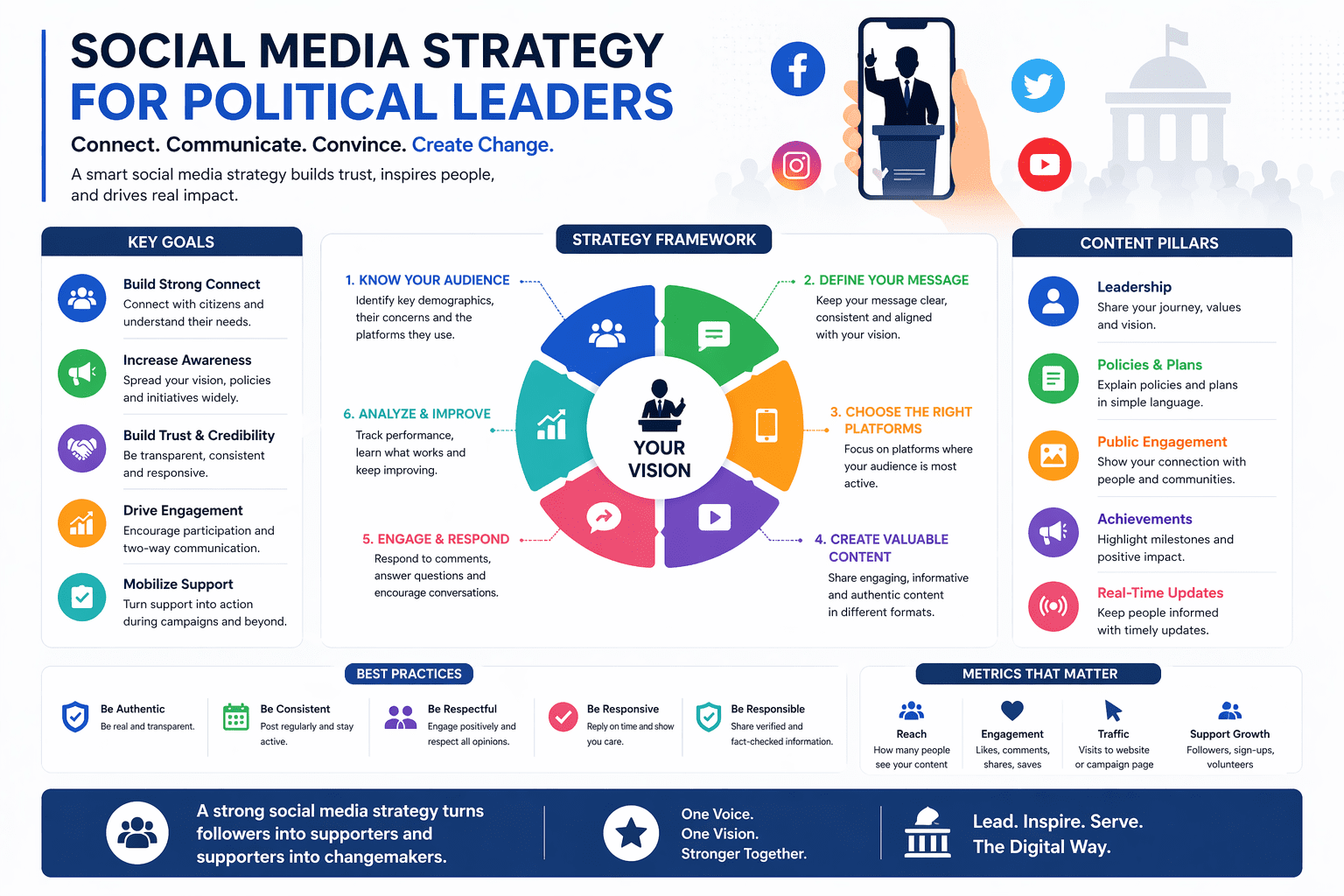
Social media strategy for political leaders has shifted from simple posting to real time perception management. Many leaders still use platforms like announcement boards, yet audiences now expect clarity and consistency. As a result, visibility alone no longer guarantees influence.
Earlier, rallies and speeches shaped public opinion for weeks. Now, digital reactions change narratives within hours, and online sentiment often outweighs offline efforts. So, leaders who ignore this shift struggle to stay relevant.
This change raises an important question. Has social media become the primary battleground of modern politics rather than just a communication tool?
- Political influence now depends more on structured digital strategy than visibility alone
- Audience understanding and content clarity drive engagement and trust
- Video and narrative content dominate modern political communication
- Consistency and timing are critical for long term impact
- Systems and workflows improve execution across campaigns
- The 2026 Political Digital Landscape
- Understanding Voter Behavior Online
- Core Framework of Strategy
- Content That Influences Voters
- Role of Social Media Management
- Power of Video
- Real World Scenario
- Success Story
- User Reviews
- Forum Discussions
- Common Mistakes
- FAQs
- Conclusion
The 2026 Political Digital Landscape
The digital ecosystem in 2026 has evolved rapidly, especially with short form content dominating attention. Algorithms now decide reach more than follower count, which reduces the advantage of legacy popularity. Therefore, even established leaders must rethink their digital presence.
Audience fragmentation has also increased significantly. Different voter groups consume content on separate platforms, so unified messaging often fails. Because of this, campaigns now require targeted communication strategies.
At the same time, skepticism has grown among users. Audiences question authenticity more than before, which makes overly polished messaging ineffective. This shift has forced political campaigns to rethink how they communicate online.
Understanding Voter Behavior Online
Voter behavior online is shaped by emotion first and logic second. People respond to relatability and tone before they process policy details. So, content that feels human often performs better than technically perfect communication.
Attention spans have shortened, which means messages must connect quickly. If content fails to capture interest within seconds, it gets ignored. Therefore, clarity and speed are essential in political messaging.
Trust signals also play a major role. Consistency, transparency, and repetition help build credibility over time. Without these elements, even strong campaigns fail to convert attention into support.
Core Framework of Strategy
Message Positioning
Every effective social media strategy for political leaders starts with clear positioning. Leaders must define their core message in simple language that can be repeated consistently. Without this clarity, content becomes scattered.
Platform Selection
Different platforms serve different purposes. Some drive awareness, while others build deeper engagement. Therefore, choosing the right platforms matters more than being active everywhere.
Content Architecture
Content must follow a structured approach instead of random posting. A mix of informative, emotional, and reactive content creates balance. Each type supports a different aspect of audience perception.
Consistency and Timing
Consistency builds familiarity, while timing increases relevance. Posting regularly keeps audiences engaged, but posting at the right moment improves impact. Both planning and adaptability are necessary.
Content That Influences Voters
Not all content creates the same level of impact. Narrative driven posts connect ideas with real experiences, which makes them more engaging. Therefore, storytelling plays a key role in political communication.
Local issue based content also performs strongly. It feels more relevant to specific communities and builds trust faster than broad messaging. This approach improves both engagement and credibility.
On the other hand, overly scripted content often fails. Audiences quickly detect a lack of authenticity. So, honest communication tends to perform better than polished but distant messaging.
Role of Social Media Management
Managing political communication manually becomes difficult at scale. Campaigns need structured systems for consistency and coordination. Without this, execution often becomes inconsistent.
One example is Social Media Management by Tech XML, which focuses on organized campaign workflows. These systems help teams maintain consistency and improve efficiency.
Additionally, campaigns benefit from tools that help them manage social media accounts effectively. Structured workflows ensure that strategy translates into execution without gaps.
Power of Video
Video has become the most effective format in political communication. It combines visuals, tone, and context, which makes it more engaging than static content. Therefore, campaigns that prioritize video often see better results.
Short videos capture attention quickly, while longer videos provide depth. This combination allows leaders to communicate both emotion and logic effectively. As a result, video becomes a central part of strategy.
However, quality remains important. Poorly edited content reduces credibility, even if the message is strong. So, professional video editing plays a critical role in maintaining impact.
Real World Scenario
A regional political leader struggled with low engagement despite regular posting. Their content focused on formal updates, which limited audience interest. As a result, their reach remained low.
After restructuring their approach, they introduced narrative driven content and local discussions. They also improved timing and platform focus. Within months, engagement increased significantly.
More importantly, audience perception improved. The leader appeared more relatable, which strengthened their digital presence.
Success Story
A mid level political campaign faced declining engagement during a critical election phase. Their messaging lacked clarity, and their audience targeting remained weak. This resulted in low interaction.
After adopting a structured social media strategy for political leaders, they refined their messaging and improved content planning. They also focused on video storytelling.
Within weeks, engagement doubled. More importantly, their message reached the right audience segments, which improved overall campaign effectiveness.
User Reviews
Rahul Mehta, Mumbai found that structured planning improved engagement significantly. He noted that consistency made a visible difference in campaign performance.
Ananya Sharma, Delhi highlighted that understanding audience behavior reduced unnecessary content. She observed that every post became more purposeful.
David Thomas, London appreciated the clarity of structured communication. He felt that campaigns became more predictable and effective.
Forum Discussions
Question by Arjun Singh, Lucknow
Is it better to focus on one platform or stay active everywhere for political campaigns?
Community Reply by Neha Verma, Jaipur
Focusing on a few strong platforms usually delivers better results than spreading efforts across too many channels.
Question by Michael Reed, New York
How important is video compared to text based content in political strategy?
Community Reply by Kavita Iyer, Bangalore
Video drives faster engagement, but text still supports deeper communication. A balanced approach works best.
Common Mistakes
Many leaders confuse activity with effectiveness. Posting frequently without a clear message reduces impact. Therefore, strategy must guide execution.
Ignoring audience feedback is another common mistake. Social media is interactive, yet many campaigns fail to engage with users. This limits trust building.
Inconsistency also creates confusion. Changing tone or message frequently weakens credibility. So, maintaining a stable narrative is essential.
FAQs
What makes a strong social media strategy for political leaders in 2026?
A strong strategy combines clear messaging, audience understanding, and consistent execution. It focuses on influence rather than visibility and adapts to changing digital behavior.
How often should political leaders post on social media?
Posting frequency depends on audience engagement and platform type. However, consistency matters more than volume for long term impact.
Is video content necessary for political campaigns?
Video improves engagement significantly because it communicates emotion and context quickly. While not mandatory, it is highly effective.
How can political leaders build trust online?
Trust develops through consistent messaging, transparency, and responsiveness. Engaging with audience feedback strengthens credibility.
Can smaller campaigns compete digitally?
Yes, smaller campaigns can compete by focusing on niche audiences and strong messaging. Strategy often matters more than budget.
Conclusion
Social media strategy for political leaders is now central to political communication. It shapes how leaders connect with voters and influence public perception.
Success depends on clarity, consistency, and understanding audience behavior. Leaders who adopt structured strategies gain stronger control over their narrative.
As digital platforms continue to evolve, political communication will become more dynamic. Those who adapt early will shape the future of engagement.





Leave a Reply