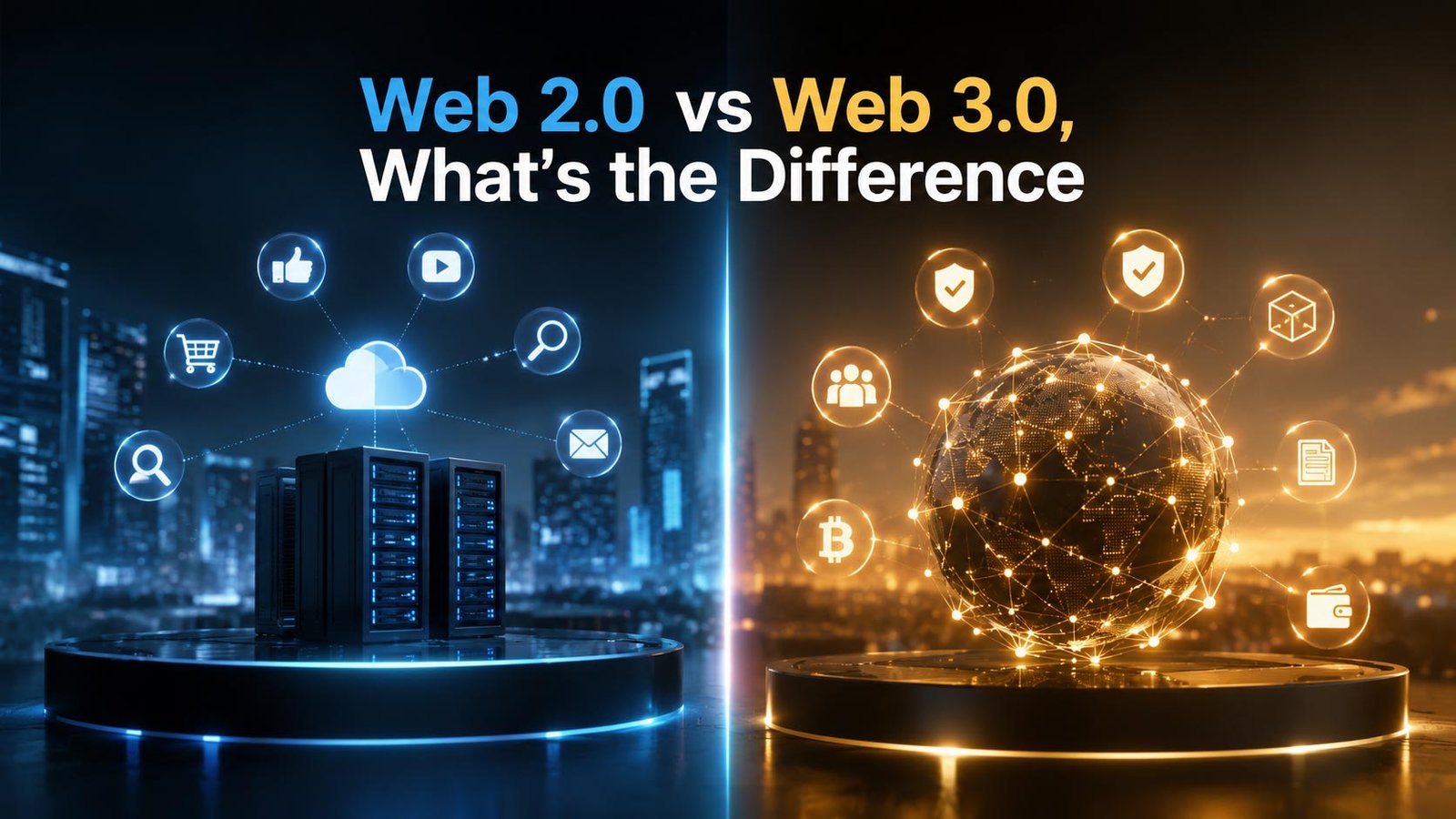
The internet is experiencing a monumental paradigm shift. If you have been paying attention to the tech industry, digital marketing, or enterprise technology, you have likely encountered the ongoing debate: Web 2.0 vs Web 3.0, what’s the difference? Understanding this evolution is no longer just for software developers or tech enthusiasts; it is a critical business imperative for founders, marketers, and enterprises looking to future-proof their digital strategies.
To truly grasp where the internet is heading, we must first understand where it began. Web 1.0 (roughly 1989 to 2005) was the “read-only” web. It was characterized by static HTML pages, decentralized open protocols, and a lack of interactive features. Users were purely consumers of information. Then came Web 2.0, the “read-write” web, which transformed the internet into a heavily interactive, social, and centralized platform. Now, we stand at the precipice of Web 3.0—the “read-write-own” web—which promises to return control to the user through blockchain technology, artificial intelligence, and decentralized architectures.
In this comprehensive guide, we will break down the core differences between Web 2.0 and Web 3.0, explore how this technological evolution impacts your digital footprint, and explain why early adoption is vital for sustainable growth.
What is Web 2.0? The Era of the Social Web and Centralization
Web 2.0 represents the current version of the internet that most of us use daily. Emerging around 2004, this iteration shifted the focus from static, informative websites to dynamic, user-generated content, interoperability, and participatory culture. The defining characteristic of Web 2.0 is the rise of massive platform ecosystems—often referred to as “Big Tech.”
In Web 2.0, users are encouraged to create content, share media, and interact with one another. This led to the explosive growth of social media platforms, blogging, podcasting, and video sharing. However, this interactivity came with a hidden cost: centralization and data harvesting.
While users generate the content and drive the engagement, massive corporations own the infrastructure, control the algorithms, and monetize the data. Your digital identity, your behavioral patterns, and your social graph are aggregated into massive centralized servers and sold to advertisers. This architecture requires businesses to heavily rely on these platforms to reach their audiences, necessitating precise and consistent planning, such as implementing a robust social media calendar strategy to maintain visibility amidst shifting, opaque algorithms.
Key Characteristics of Web 2.0:
- User-Generated Content (UGC): The shift from corporate-created content to platforms powered by user contributions.
- Centralized Networks: Data is stored on servers owned by singular, powerful corporate entities.
- Monetization through Advertising: The primary revenue model involves harvesting user data to serve highly targeted digital advertising.
- Mobile-First Design: An ecosystem heavily reliant on smartphone applications and constant connectivity.
What is Web 3.0? The Dawn of the Decentralized Web
Web 3.0 (or Web3) is the next evolutionary stage of the internet. If Web 2.0 made you the product, Web 3.0 makes you the owner. The foundational philosophy of Web 3.0 is decentralization, aiming to create a trustless, permissionless internet where centralized monopolies no longer hold the keys to communication and commerce.
Powered primarily by blockchain technology, Web 3.0 replaces centralized databases with distributed ledgers. This means data is decentralized, secured by cryptography, and governed by consensus mechanisms rather than corporate boardrooms. Users own their data, their digital assets (via NFTs and tokens), and their identities across the web.
Beyond blockchain, Web 3.0 also incorporates the Semantic Web and Artificial Intelligence (AI). The Semantic Web allows machines to process information with human-like understanding, meaning search engines and applications can parse data based on meaning and context rather than just keywords. This creates a hyper-personalized, intelligent internet experience. The shift is so profound that forward-thinking leaders are already recognizing why businesses are moving towards Web 3.0 to secure their competitive advantage, ensure data compliance, and foster deeper, more authentic trust with their user base.
Key Characteristics of Web 3.0:
- Decentralization: Applications (dApps) run on blockchain networks or peer-to-peer (P2P) nodes rather than centralized servers.
- Data Ownership: Users retain complete ownership of their digital identity and data, deciding if, when, and how it is monetized.
- Artificial Intelligence & Machine Learning: Advanced AI processes vast amounts of data to provide intuitive, context-aware user experiences.
- Trustless & Permissionless: Participants can interact directly via smart contracts without needing a trusted third-party intermediary.
Web 2.0 vs Web 3.0: A Feature-by-Feature Comparison
To fully understand the shift, we must compare the two architectures directly. Below is a comprehensive breakdown of the core differences that define the transition from Web 2.0 to Web 3.0.
| Feature | Web 2.0 (The Social Web) | Web 3.0 (The Decentralized Web) |
|---|---|---|
| Network Architecture | Centralized client-server models controlled by massive tech corporations. | Decentralized peer-to-peer networks and distributed blockchain ledgers. |
| Data Ownership | Platforms own and monetize user data. Privacy is often compromised for access. | Users fully own their data and digital assets via cryptographic keys and digital wallets. |
| Application Type | Web Apps and Mobile Apps built on closed-source, proprietary codebases. | Decentralized Applications (dApps) utilizing transparent, open-source smart contracts. |
| Financial System | Relies heavily on traditional fiat currency and centralized payment gateways (banks, Stripe, PayPal). | Utilizes decentralized finance (DeFi) via cryptocurrencies and utility tokens without intermediaries. |
As the table illustrates, the leap from Web 2.0 to Web 3.0 is not merely a software update; it is a fundamental redesign of internet infrastructure. Web 2.0 prioritizes ease of use and social connectivity at the expense of privacy and control. Web 3.0 prioritizes sovereignty, security, and open protocols, albeit currently facing challenges with mass adoption and user-experience friction.
How the Transition Affects SEO, GEO, and Digital Marketing
The evolution from Web 2.0 to Web 3.0 carries massive implications for digital marketers, SEO specialists, and content creators. We are currently witnessing the rise of Generative Engine Optimization (GEO) and Answer Engine Optimization (AEO).
In Web 2.0, SEO is heavily reliant on keyword density, backlink profiles, and satisfying centralized search engine algorithms (like Google). You create content, optimize for specific search terms, and hope to rank on the first page.
In Web 3.0, the integration of Artificial Intelligence and Semantic Web technologies means search engines are becoming “answer engines” (e.g., ChatGPT, Perplexity, Gemini, AI Overviews). These engines do not just retrieve links; they synthesize information to generate direct answers. Therefore, modern marketing must adapt by focusing on entity-based SEO, establishing robust EEAT (Experience, Expertise, Authoritativeness, Trustworthiness), and structuring data via schema markup to ensure AI models can seamlessly digest and recommend your brand’s content. Marketers will need to pivot from renting audiences on centralized platforms to building direct, token-incentivized communities.
Why Tech XML is Your Ideal Partner in the Web 3.0 Era
Navigating the complex transition from traditional digital ecosystems to the sophisticated world of AI, blockchain, and semantic algorithms requires more than just basic marketing knowledge; it requires deep technical expertise and visionary strategy. This is where Tech XML stands apart.
At Tech XML, we do not just follow trends; we engineer them. We understand that your business needs a holistic strategy that bridges the gap between the proven conversion tactics of Web 2.0 and the decentralized, AI-driven innovations of Web 3.0. Our team of seasoned technologists and digital strategists applies rigorous EEAT principles to elevate your brand’s authority. Whether you need advanced schema structuring for AEO, cutting-edge SEO optimization, or a cohesive content architecture, Tech XML provides the bespoke, data-driven solutions required to dominate modern search ecosystems and future-proof your digital presence.
Frequently Asked Questions (AEO & Featured Snippet Optimized)
Is Web 3.0 the same thing as the Metaverse?
No, they are distinct but related concepts. Web 3.0 is the decentralized architectural foundation of the future internet, focusing on blockchain and ownership. The Metaverse refers to a spatial, immersive, 3D digital environment (often accessed via VR/AR) where people interact. The Metaverse will likely run on Web 3.0 infrastructure, but they are not synonymous.
How will Web 3.0 affect everyday internet users?
For the average user, the early stages of Web 3.0 will feel similar to Web 2.0 on the surface, but the underlying mechanics will change. Users will likely log into platforms using secure digital wallets rather than email/password combos, they will have granular control over what personal data they share, and they may earn tokens or micro-payments for their content creation and attention.
Do businesses need to abandon Web 2.0 strategies right now?
Absolutely not. The internet is in a transitional phase often dubbed “Web 2.5.” Businesses must continue leveraging Web 2.0 channels (like traditional SEO, social media, and email marketing) for current revenue generation, while simultaneously experimenting with Web 3.0 technologies (like tokenized loyalty programs or blockchain data security) to prepare for the inevitable shift.
Ready to Dominate Your Market?
Stop wasting budget on fragmented tactics. Partner with Tech XML to build a cohesive growth machine.






Leave a Reply