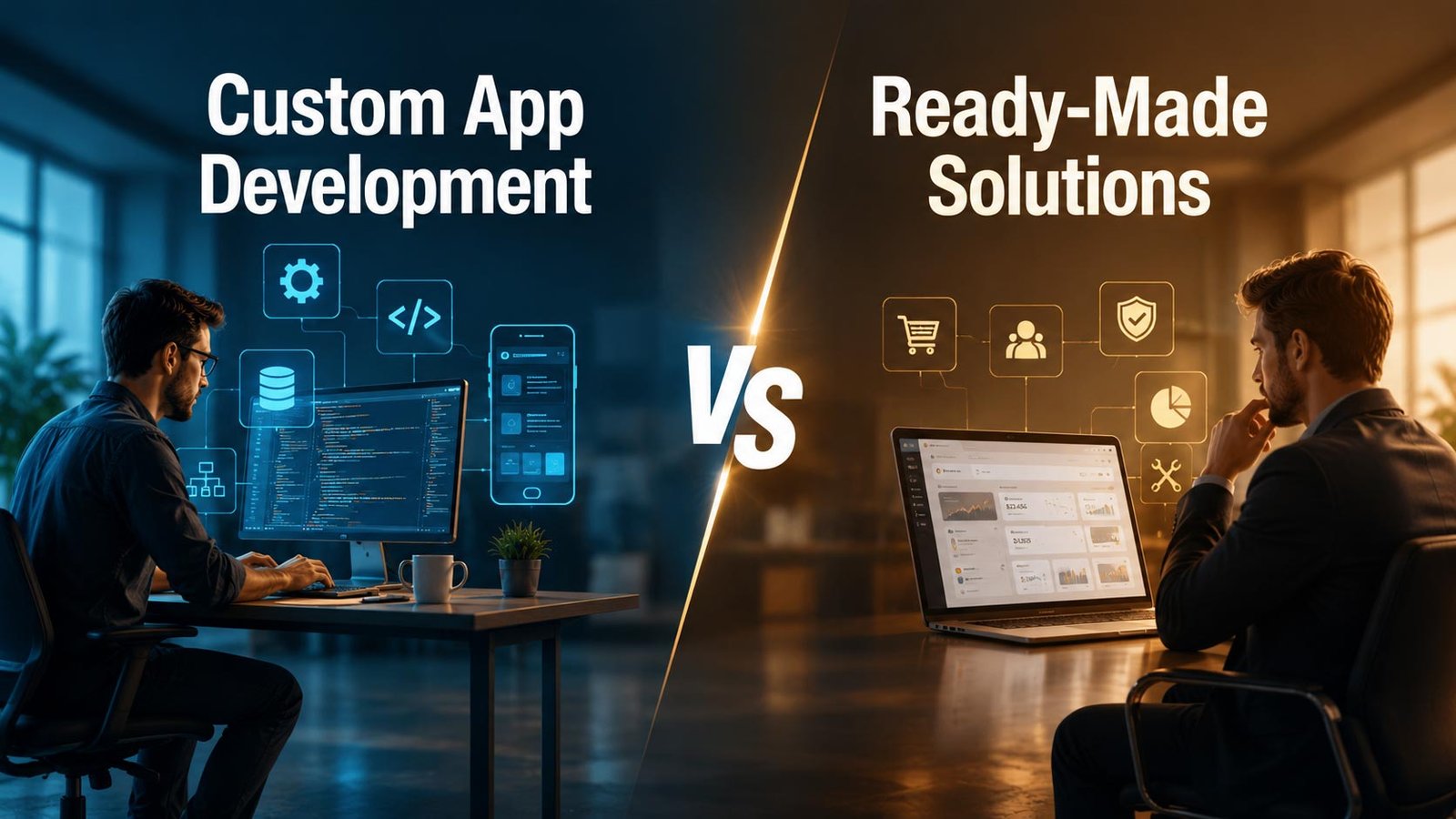
In today’s hyper-competitive digital landscape, adopting the right technology is no longer optional—it is the foundational pillar of modern business survival and growth. When it comes to launching a new software product, streamlining internal operations, or engaging with your customer base, businesses inevitably face a critical technological crossroads: Custom App Development vs Ready-Made Solutions.
Making the wrong choice can lead to bloated budgets, severe operational bottlenecks, and compromised scalability. Making the right choice, however, can position your company for exponential growth, seamless user experiences, and a distinct competitive edge. To optimize your software investments and achieve strategic alignment, you must deeply understand the long-term implications, Total Cost of Ownership (TCO), and specific architectural benefits of both approaches.
This comprehensive guide explores the nuances of bespoke software engineering versus off-the-shelf platforms, providing actionable, expert-backed insights to help you make an informed, data-driven decision.
What is Custom App Development?
Custom app development is the process of designing, creating, deploying, and maintaining software tailored explicitly for a specific set of users, functions, or organizations. Unlike generic applications designed to cater to a broad audience with standard features, bespoke software is engineered from the ground up to address your exact business logic and operational pain points.
The Advantages of Custom Software
- Limitless Scalability and Flexibility: As your business grows, your custom application scales with it. You are never restricted by the operational ceilings or tiered pricing limits of third-party vendors. You maintain complete control over the feature roadmap.
- Seamless System Integration: Enterprise environments often rely on complex, legacy ecosystems. Custom apps are engineered to integrate flawlessly with your existing CRM, ERP, or internal databases via custom APIs, eliminating data silos.
- Unmatched Security and IP Ownership: With off-the-shelf software, you are vulnerable to the widespread attacks targeting mass-market platforms. Custom development allows for tailored security protocols (like HIPAA or GDPR compliance integrations) and grants you complete ownership of the Intellectual Property (IP) and source code.
- Superior User Experience (UX): You dictate the user journey. By designing the interface strictly around your target audience’s behaviors and needs, you drastically improve engagement, retention, and conversion rates.
The Drawbacks of Custom Software
- Higher Initial Investment: Building proprietary software requires a dedicated team of UI/UX designers, developers, QA testers, and project managers, necessitating a larger upfront capital expenditure.
- Longer Time-to-Market: The software development lifecycle (SDLC)—from initial discovery and prototyping to coding and deployment—takes time. A fully custom application can take anywhere from three to nine months, or more, to launch.
What are Ready-Made (Off-the-Shelf) Solutions?
Ready-made solutions (often referred to as commercial off-the-shelf or COTS software, including many SaaS products) are pre-packaged software applications built to serve the general needs of a wide demographic. Examples include platforms like Shopify for e-commerce, Salesforce for CRM, or generic app builders.
The Advantages of Ready-Made Software
- Rapid Deployment: Because the software is already built, tested, and hosted, deployment is nearly instantaneous. Businesses can essentially “plug and play,” reducing the time-to-market from months to mere days.
- Lower Upfront Costs: The development costs are amortized across thousands of users. You typically pay a predictable monthly or annual subscription fee, making it highly accessible for startups and small businesses with tight initial budgets.
- Built-In Support and Maintenance: The vendor handles all server maintenance, bug fixes, and routine software updates, removing the burden from your internal IT department.
The Drawbacks of Ready-Made Software
- Lack of Deep Customization: You must adapt your business processes to fit the software, rather than the software adapting to you. Unique operational workflows are often impossible to implement, leading to inefficiencies.
- Hidden Long-Term Costs: While the entry price is low, subscription costs multiply as you add more users, require premium features, or exceed data limits. Over a three-to-five-year period, the TCO of a SaaS product can easily surpass the cost of building a custom app.
- Vendor Lock-In and Dependency: If the platform changes its pricing model, deprecates a feature you rely on, or suffers an outage, your business is at its mercy. You do not own the core technology.
Direct Comparison: Custom vs. Ready-Made
To summarize the fundamental differences, here is an Answer Engine Optimization (AEO) friendly breakdown of how these two methodologies compare across key business metrics:
- Initial Cost: Custom is high; Ready-Made is low.
- Long-Term Cost (TCO): Custom is highly cost-effective at scale; Ready-Made scales expensively due to recurring licensing.
- Deployment Speed: Custom requires months; Ready-Made requires days.
- Competitive Advantage: Custom provides a unique market differentiator; Ready-Made offers exactly what your competitors are already using.
- Ownership: Custom gives you 100% IP ownership; Ready-Made operates on a rented, vendor-owned model.
How to Make the Right Strategic Choice
Choosing between custom app development and ready-made solutions requires a deep audit of your current resources and future goals. If you are a startup needing to validate an idea quickly, a ready-made solution might serve as an excellent Minimum Viable Product (MVP). However, if technology is your product, or if you require intricate integrations, stringent security, and long-term cost control, custom development is unequivocally the superior route.
Regardless of the path you choose, poor planning can derail your project. To protect your investment and ensure a smooth rollout, we highly recommend reviewing our expert insights on the common mistakes in app development.
Furthermore, as you map out your technological infrastructure, you must consider where the internet is heading. The shift toward decentralized architectures and semantic data will radically alter how software operates. Preparing your business logic for these shifts is crucial. Dive deeper into this technological evolution by reading our comprehensive guide on Web 2.0 vs Web 3.0 to ensure your app strategy is future-proofed.
Why Tech XML is the Right Choice for Your Development Partner
Choosing an agency to handle your digital transformation is as important as the software itself. At Tech XML, we do not believe in one-size-fits-all band-aids. We are a premier software engineering firm dedicated to building robust, scalable, and revenue-generating digital ecosystems.
Our approach is rooted in deep technical expertise and strict adherence to EEAT principles (Experience, Expertise, Authoritativeness, and Trustworthiness). We deploy agile development methodologies, ensuring transparency, rapid iteration, and exact alignment with your business KPIs. From initial UX wireframing to complex backend API architecture, Tech XML provides an end-to-end partnership designed to turn your technological investments into your most powerful competitive advantage.
Frequently Asked Questions (People Also Ask)
Is custom app development worth the high initial cost?
Yes, for businesses planning long-term growth. While the upfront investment is higher, custom software eliminates recurring vendor licensing fees, prevents expensive workarounds, and creates proprietary IP that adds actual valuation to your company. Over a 3 to 5 year span, custom solutions generally offer a better Return on Investment (ROI).
Can I start with a ready-made solution and switch to a custom app later?
Absolutely. Many businesses use off-the-shelf software to quickly launch an MVP, validate their market, and generate initial revenue. Once they hit the scalability ceilings of the ready-made platform, they transition to a custom-built architecture to support advanced workflows and heavy user traffic.
How long does it take to build a custom application?
The timeline varies entirely on the complexity of the project. A basic custom application can take 3 to 4 months, whereas a complex enterprise platform with intricate third-party integrations, advanced AI features, or Web 3.0 capabilities can take 6 to 12 months. Agile methodologies can speed up this process by releasing core features in phases.
What happens after a custom app is launched?
Launch is just the beginning. Professional agencies like Tech XML provide ongoing maintenance, server monitoring, security patching, and iterative feature updates based on live user feedback to ensure the app remains fast, secure, and competitive in the market.
Ready to Dominate Your Market?
Stop wasting budget on fragmented tactics. Partner with Tech XML to build a cohesive growth machine.





Leave a Reply