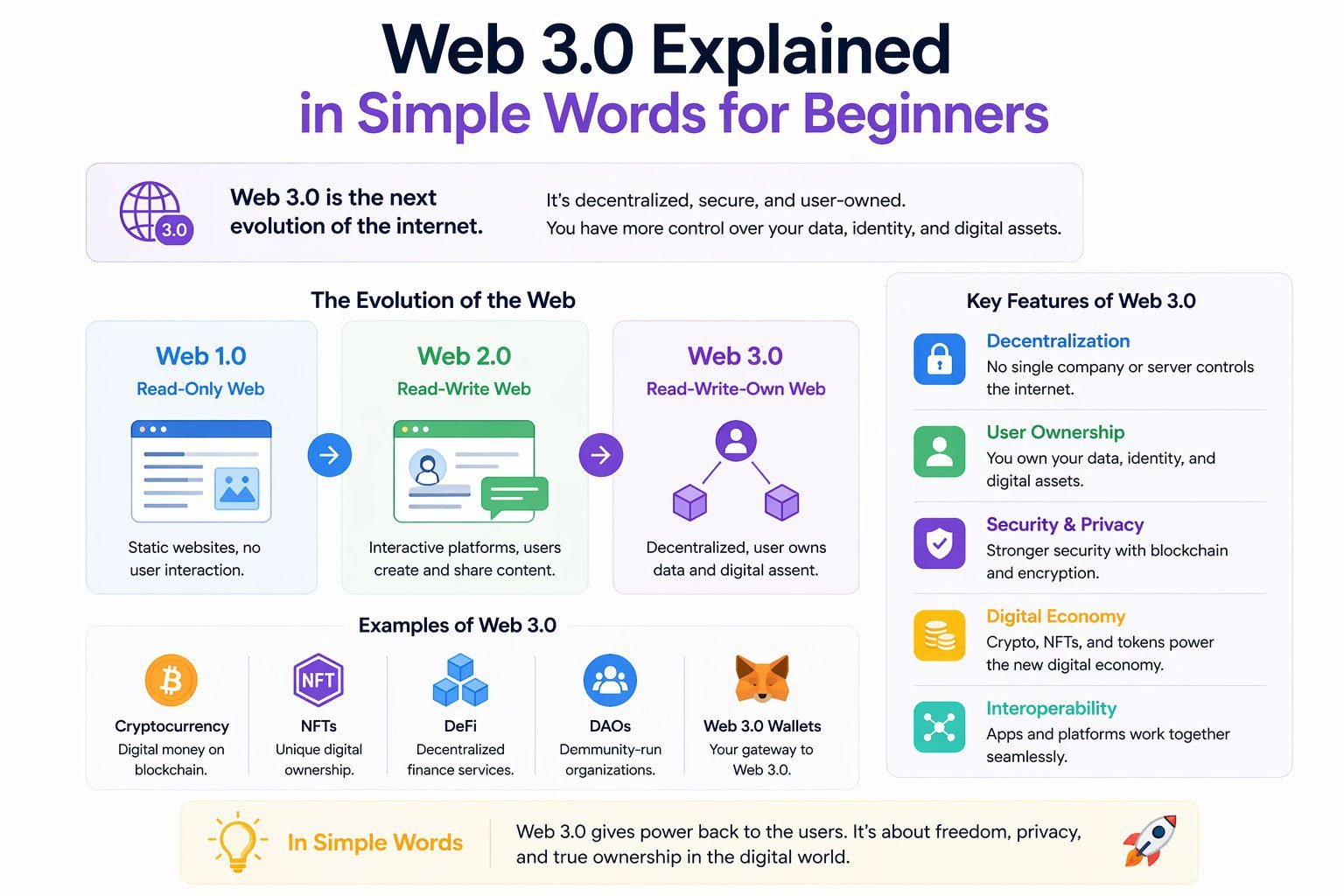
Web 3.0 explained has become a widely discussed topic, yet many users still struggle to understand what it actually means. The term appears across conversations about crypto, apps, and ownership, but clarity often feels missing. This confusion exists because most explanations lean heavily on technical language instead of real world understanding.
This shift is not just another trend in technology. It reflects a deeper transformation in how people interact with the internet itself. Users are no longer passive participants, as they are gradually becoming owners of their data and identity, which changes how digital platforms operate.
- Web 3.0 shifts control from platforms to users
- Blockchain enables transparency and ownership
- Decentralized apps reduce reliance on big tech
- Users can directly benefit from their activity
- Adoption is growing steadily but still evolving
Table of Contents
- Evolution of the Internet
- What Is Web 3.0
- Key Technologies
- How It Is Different
- Real World Use Cases
- User Scenario
- Case Study
- Role of Companies
- Challenges
- User Reviews
- Forum Discussions
- Digital Connections
- Future Outlook
- FAQs
- Conclusion
Evolution of the Internet
The internet has evolved through distinct stages over time. Web 1.0 introduced static websites where users could only read information. Interaction remained limited, and content rarely changed.
Web 2.0 transformed the experience by introducing social platforms, apps, and user generated content. People could create and share content easily, yet companies retained control over data and visibility. This created a centralized digital environment.
Now Web 3.0 represents the next phase. It shifts control away from centralized platforms and distributes it among users. This evolution changes the structure of the internet rather than simply improving it.
What Is Web 3.0
In simple terms, web 3.0 explained refers to an internet where users own their data and digital identity. Instead of relying on centralized systems, information exists across decentralized networks. This creates a more balanced and user focused environment.
Users can move across platforms without losing access to their content or assets. This portability introduces flexibility that did not exist before. It also reduces dependency on a single company or service.
For beginners, the difference becomes clear when compared directly. In Web 2.0, users generate value while platforms capture it. In Web 3.0, users retain ownership and participate more actively in that value.
Key Technologies
Web 3.0 operates on technologies designed for decentralization. Blockchain acts as a distributed ledger that stores data securely across multiple nodes. This ensures transparency and prevents single point control.
Smart contracts automate agreements without intermediaries. They execute actions based on predefined conditions, which increases efficiency and reduces reliance on traditional systems.
Decentralized applications function similarly to regular apps but operate without central servers. This structure enhances security while giving users greater control over their data and interactions.
How It Is Different
The key difference between Web 2.0 and Web 3.0 lies in ownership and control. In current systems, platforms manage user data and interactions. Users depend on these platforms for access and reach.
In Web 3.0, control shifts to the user. Individuals manage their identities and digital assets directly, which reduces dependency on centralized systems. This creates a more balanced digital structure.
Monetization also changes significantly. Instead of platforms earning from user activity, users can directly benefit from their participation. This realignment transforms the digital economy.
Real World Use Cases
Web 3.0 is already present across multiple industries. In finance, decentralized systems allow users to lend, borrow, and trade without banks. This improves accessibility and reduces barriers.
Gaming is another strong example. Players can own in game assets and trade them freely across platforms. This adds real value to digital items that previously remained locked within a single ecosystem.
Content platforms are evolving as well. Some systems reward creators directly, which aligns incentives better and reduces dependency on advertising based models.
User Scenario
Consider a user who interacts with multiple apps daily. In traditional systems, each platform stores user data separately. This requires multiple logins and creates dependency on each service.
In a Web 3.0 environment, one digital identity works across platforms. The user controls what data is shared and retains ownership of their assets. This reduces friction and improves flexibility.
This shift creates a more seamless digital experience. It allows users to move across services without losing their presence or data.
Case Study
A fintech startup adopted Web 3.0 principles to build a decentralized payment platform. Instead of relying on traditional systems, it used blockchain based transactions to process payments efficiently.
Users experienced faster transactions and lower fees. Transparency increased trust, as every transaction remained visible and secure. Adoption grew steadily because users felt more in control.
This case highlights how Web 3.0 applies in real business scenarios. It demonstrates practical value rather than theoretical potential.
Role of Companies
Developing Web 3.0 solutions requires specialized expertise. Companies in this space focus on blockchain architecture, decentralized systems, and secure application design.
One example is a Web 3.0 Development Company like Tech XML, which builds modern digital products aligned with decentralized ecosystems. These companies help businesses move from concept to execution.
Their role becomes more important as adoption increases. They simplify complex systems and ensure scalable solutions for real world applications.
Challenges
Web 3.0 still faces several challenges despite its potential. Scalability remains a concern, as decentralized systems can struggle with high demand. This affects performance and usability.
Regulatory uncertainty also creates limitations. Governments continue to adapt to decentralized technologies, which introduces risk for businesses and users.
User adoption takes time as well. Many users find the concepts difficult to understand, which slows widespread acceptance.
User Reviews
Rahul Mehta, Mumbai
I used a decentralized finance app recently, and the experience felt different. I had more control over my funds, which increased my confidence in the platform.
Emily Carter, New York
At first, Web 3.0 felt confusing, but after understanding the basics, it became clear. Owning my digital identity made the experience feel more secure.
Arjun Singh, Delhi
I explored a blockchain gaming platform, and it changed how I view digital assets. Ownership added real value to the experience.
Forum Discussions
Neha Sharma, Bangalore
Question: Is Web 3.0 practical for everyday users?
Community Reply by David Lee, Singapore: Yes, platforms are becoming easier to use, which makes adoption more realistic.
Mark Wilson, London
Question: Will Web 3.0 replace current platforms?
Community Reply by Ankit Verma, Pune: Not immediately, as both systems will likely coexist during the transition period.
Digital Connections
Web 3.0 connects with broader digital strategies such as app development and user experience design. Understanding Android vs iOS app development helps businesses align their products with user needs.
Trust remains equally important. Even decentralized platforms must build credibility. Learning how a website builds trust and increases sales highlights how user confidence drives adoption.
These connections show that Web 3.0 enhances existing systems rather than replacing them entirely. It works alongside current technologies while improving ownership and control.
Future Outlook
Web 3.0 will continue evolving beyond 2026. Users may interact with decentralized systems without realizing it. This seamless experience will drive broader adoption.
Technology improvements will address current limitations. Scalability and usability will improve, making platforms more accessible to a wider audience.
The future focuses on improving the internet rather than replacing it. Web 3.0 represents a gradual shift toward a more balanced digital ecosystem.
FAQs
What is Web 3.0 in simple terms for beginners?
Web 3.0 is a decentralized version of the internet where users control their data and identity instead of relying on centralized platforms.
How is Web 3.0 different from Web 2.0?
Web 2.0 depends on centralized platforms that manage user data, while Web 3.0 distributes control across networks and gives ownership back to users.
Is Web 3.0 only about cryptocurrency?
No, Web 3.0 includes decentralized apps, smart contracts, and digital identity systems, not just cryptocurrency based use cases.
Can beginners easily use Web 3.0 platforms?
Yes, many platforms now offer user friendly interfaces, although some learning is still required to fully understand how they work.
Is Web 3.0 the future of the internet?
Web 3.0 is expected to play a major role in the future, although it will coexist with current systems as adoption gradually increases.
Conclusion
Web 3.0 explained in simple terms is about shifting control back to users. It changes how data, identity, and value move across the internet. While challenges remain, the direction continues to become clearer.
As adoption grows, Web 3.0 will feel less like a new concept and more like a natural part of digital life. Understanding it today helps users and businesses stay prepared for what comes next.





Leave a Reply