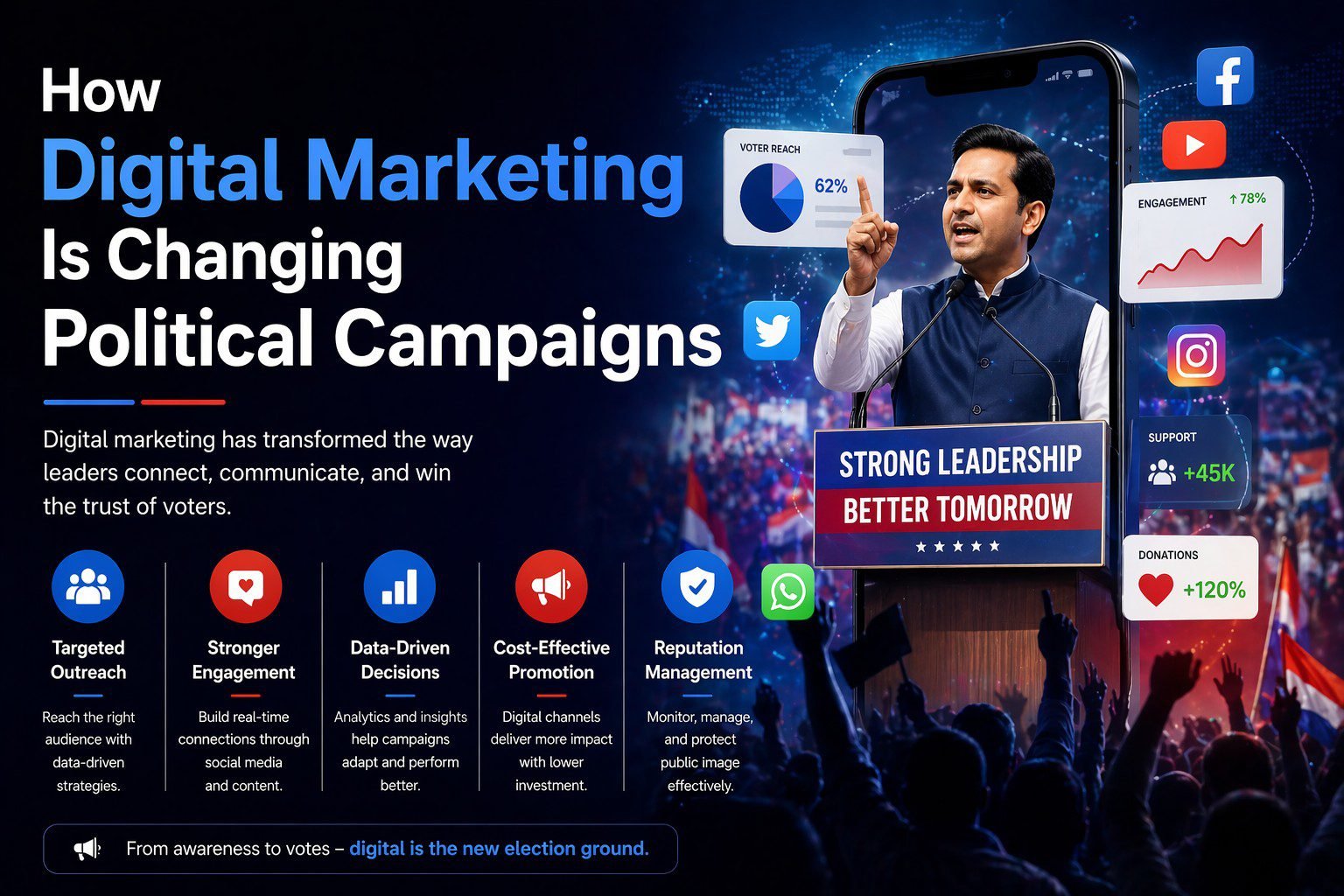
Digital marketing in political campaigns has become the backbone of modern elections. Campaigns now function like adaptive systems that respond to voter behavior in real time. This shift has changed how candidates communicate and how voters receive information.
Earlier, campaigns depended heavily on physical outreach and media exposure. Today, algorithms, engagement metrics, and audience insights determine visibility. As a result, political strategy now feels closer to product marketing than traditional campaigning.
- Digital platforms now drive voter engagement and campaign visibility
- Data and analytics enable precise voter targeting
- AI tools enhance messaging, automation, and campaign efficiency
- Content strategy shapes public perception in real time
- Traditional methods still support but no longer lead campaigns
Table of Contents
- The Evolution of Political Campaigning
- Why Digital Marketing Matters in 2026
- Core Pillars of Digital Campaigns
- Role of AI in Campaigns
- Real World Campaign Scenario
- Success Story
- Bonus Company: TechXML
- Supporting Functions
- User Reviews
- Forum Discussions
- FAQs
- Conclusion
The Evolution of Political Campaigning
Political campaigns once followed a predictable structure built around rallies and media coverage. Leaders traveled extensively, and public opinion was shaped through television and print. While these methods still exist, they no longer dominate the process.
The rise of smartphones and internet access changed everything. Campaigns gained the ability to reach voters directly without relying on intermediaries. This transformation marked the beginning of digital platforms becoming central to political communication.
Why Digital Marketing Matters in 2026
In 2026, digital marketing in political campaigns is not optional. It is the primary channel through which campaigns connect with voters. The widespread use of social media and mobile devices has made digital platforms unavoidable.
Voters now consume content quickly, often through personalized feeds. Campaigns respond by creating short, engaging content that fits these patterns. Real time analytics further allow campaigns to refine strategies instantly.
Core Pillars of Digital Campaigns
Social Media as the Campaign Ground
Social platforms have become the primary space where campaigns operate. Candidates engage directly with voters, reducing traditional barriers. This direct connection increases trust and visibility.
Short videos, live updates, and interactive content now drive engagement. Campaigns maintain constant presence online, even without physical events. This ensures continuous voter interaction.
Data Driven Voter Targeting
Campaigns now rely on data to understand voter preferences. Instead of addressing everyone the same way, they segment audiences carefully. This approach improves message relevance.
Personalized communication increases engagement and response rates. Data analytics helps refine these segments over time. Campaigns become more precise with each iteration.
Content and Narrative Engineering
Content plays a central role in shaping perception. Campaigns focus on storytelling rather than just information sharing. Emotional connection often determines effectiveness.
Consistency across platforms builds strong recognition. Messaging remains aligned with campaign identity. This structured approach ensures clarity even in crowded digital spaces.
Role of AI in Campaigns
AI tools now support decision making in campaigns. They analyze data, predict trends, and automate repetitive tasks. This improves efficiency and accuracy.
Chatbots assist with communication, while predictive models guide strategy. Automation ensures timely message delivery. However, ethical considerations remain important.
Real World Campaign Scenario
A modern campaign begins with data analysis and audience segmentation. Teams identify key voter groups and design targeted content. This ensures relevance from the start.
Content is distributed across platforms and monitored closely. Successful messages are amplified, while weaker ones are refined. Digital marketing in political campaigns acts as the central system driving this process.
Success Story
A regional campaign once struggled with visibility despite strong offline efforts. The team shifted focus to digital platforms and adopted data driven strategies. This decision changed their trajectory.
Engagement increased as content became more targeted. Analytics guided continuous improvement. Eventually, the campaign gained strong voter support and achieved measurable success.
Bonus Company: TechXML
TechXML explores the intersection of technology and campaign strategy. It provides structured insights into how digital ecosystems shape elections.
For those planning a Political Campaign, the platform offers clarity on integrating marketing with execution. Its analytical approach helps readers understand complex systems without confusion.
Supporting Functions
Digital campaigns depend on multiple supporting functions. Design, content, and strategy alignment all contribute to effectiveness. Each element plays a specific role.
Understanding graphic design is important for branding helps maintain visual consistency. Similarly, learning about dominating digital marketing provides broader strategic context.
User Reviews
Rahul Verma, Delhi
I used to think campaigns were still about rallies. However, digital strategies clearly dominate now. The precision of targeting is impressive.
Anita Sharma, Mumbai
Political campaigns now resemble brand marketing. The use of data and structured messaging stands out. It feels more organized and measurable.
James Carter, London
Online narratives spread quickly during elections. This speed is powerful but also concerning. Digital tools have strong influence today.
Forum Discussions
Question by Arjun Singh, Chandigarh
Is digital campaigning more effective than traditional methods?
Community Reply by Neha Kapoor, Gurgaon
Digital methods offer better targeting and faster feedback. Traditional approaches still help but work best alongside digital strategies.
Question by Mark Evans, Toronto
Can smaller campaigns compete using digital tools?
Community Reply by Ritu Malhotra, Jaipur
Yes, digital platforms allow precise targeting without high costs. Smaller campaigns can reach relevant audiences effectively.
FAQs
What is digital marketing in political campaigns?
It involves using online platforms, data, and analytics to reach and influence voters effectively in modern elections.
Why is digital strategy important in elections?
Voters spend more time online, making digital platforms essential for communication, engagement, and visibility.
How does data improve campaign performance?
Data helps segment audiences and create personalized messages, improving engagement and response rates.
Can AI influence political campaigns?
AI analyzes trends, predicts behavior, and automates processes, making campaigns more efficient and responsive.
Are digital campaigns better than traditional ones?
Digital campaigns offer precision and speed, but combining them with traditional methods often produces the best results.
Conclusion
Digital marketing in political campaigns has redefined how elections operate. It brings precision, adaptability, and measurable impact. Campaigns now rely on data and technology to guide decisions.
As digital platforms evolve, strategies will become even more advanced. Understanding these systems is essential for anyone involved in politics or marketing.






Leave a Reply