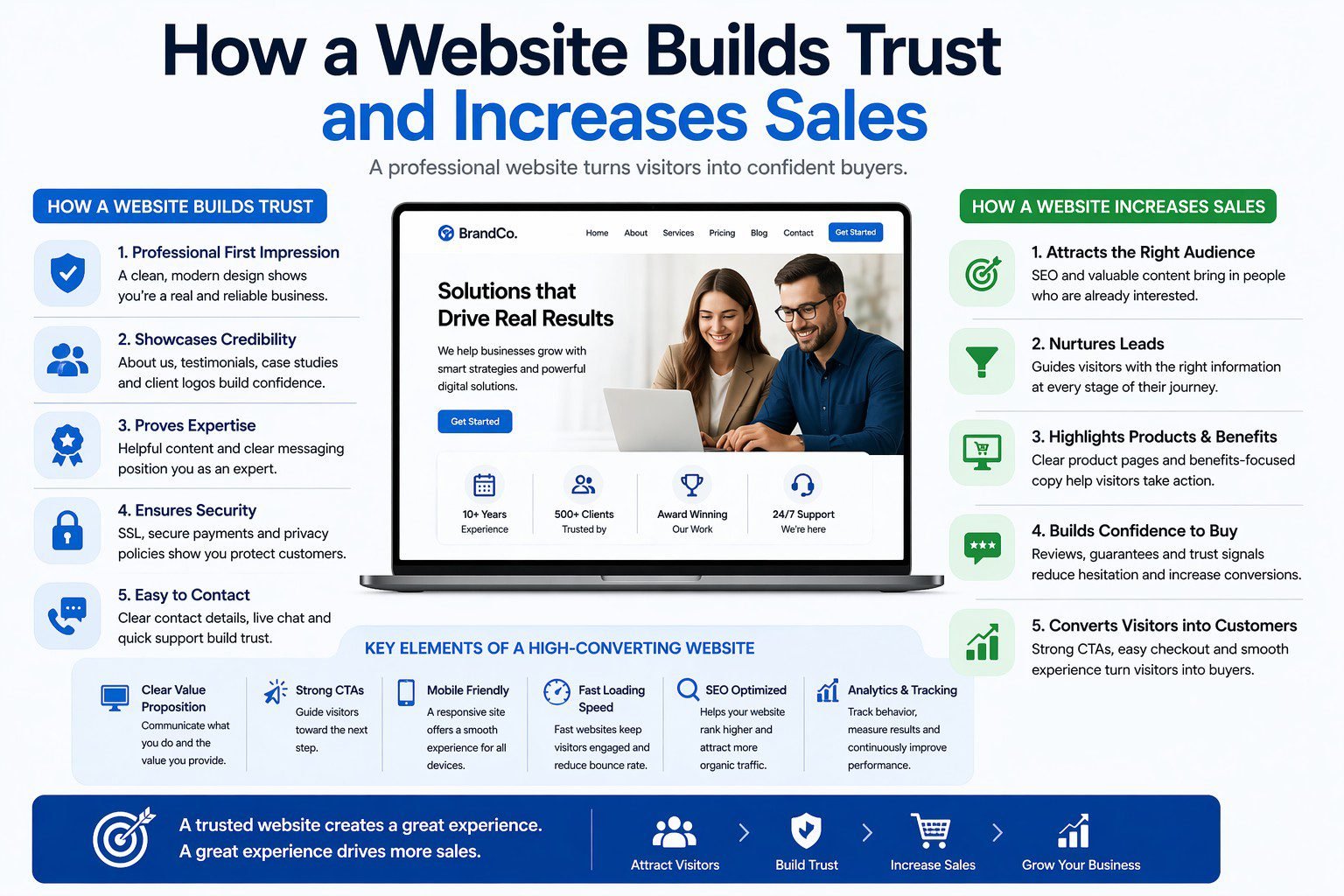
A website builds trust and increases sales only when users feel confident enough to stay, explore, and act. That gap between visiting and trusting has widened in 2026 as users evaluate faster than before. They do not browse casually anymore, they judge quickly and decide within seconds.
You can observe this behavior daily. A user lands on a website, pauses briefly, and either scrolls or leaves. That decision reflects whether the platform feels reliable or uncertain from the start.
So the real challenge is no longer traffic alone. It is whether your website earns belief instantly.
Key Highlights
- Trust is now the primary driver of online conversions
- Design, content, and UX collectively shape user perception
- Small credibility signals significantly impact buying decisions
- Consistent branding improves long term engagement
- Optimized websites reduce bounce rates and increase sales
Table of Contents
- Shift in Digital Trust Behavior
- First Impressions and Design
- Content That Builds Confidence
- User Experience as Trust Signal
- Social Proof and Validation
- Real World Scenario
- Success Story
- Brand Consistency
- Hidden Cost of Low Trust
- Growth Through Content and Reach
- Bonus Insight
- User Reviews
- Forum Discussions
- FAQs
- Conclusion
Shift in Digital Trust Behavior
User behavior has evolved significantly in recent years. Earlier, visitors explored multiple pages before forming opinions. Now, they scan a single screen and make quick judgments.
This shift comes from constant exposure to digital platforms. Users recognize patterns of trust and risk instantly. As a result, website user experience signals now carry more weight than written claims.
Because of this change, trust signals in web design act as the first filter before users consider any offering.
First Impressions and Design
Design plays a deeper role than most businesses assume. A clean layout and readable typography quietly communicate reliability. Meanwhile, cluttered visuals create hesitation.
Conversion focused web design is about clarity rather than decoration. When users understand where to look and what action to take, they feel in control.
This sense of control builds trust. And trust keeps users engaged longer.
Content That Builds Confidence
Content still matters, but its role has shifted. Users look for clarity rather than long explanations. If messaging feels vague or exaggerated, confidence drops quickly.
Website credibility factors often include transparency and honesty. Clear service explanations and grounded tone improve user perception. When content feels real, users feel respected.
And respected users are more likely to continue exploring.
User Experience as Trust Signal
A smooth experience often goes unnoticed, but poor usability stands out immediately. Slow pages and confusing navigation create friction. That friction quickly turns into doubt.
Improving website conversions often begins with removing these barriers. When users move easily, they interpret the platform as reliable.
Website user experience signals such as speed and responsiveness silently build confidence.
Social Proof and Validation
People trust other people more than brands. Reviews and testimonials act as external validation. They show that others have already taken the risk.
Trust signals in web design now include visible feedback. When users see real experiences, hesitation reduces.
This directly supports efforts to increase online sales.
Real World Scenario
Consider two websites offering similar services. One looks outdated with unclear messaging. The other feels structured and transparent with visible reviews.
Most users choose the second option without deep comparison. Not because it is better, but because it feels safer.
This is how a website builds trust and increases sales in real situations.
Success Story
A service business struggled with low conversions despite steady traffic. Their website lacked structure and visible trust signals.
They improved layout, simplified messaging, and added testimonials. Within months, engagement increased and bounce rates dropped.
Conversions improved steadily through better website optimization strategies.
Brand Consistency
Consistency builds familiarity, and familiarity builds trust. When visuals and messaging align, users feel confident.
Inconsistent branding creates confusion and doubt. It signals instability to users.
Building customer trust online depends on reducing this confusion.
Hidden Cost of Low Trust
Low trust appears in subtle ways. Users leave quickly, abandon carts, and avoid engagement.
Many businesses focus on traffic instead of credibility. However, traffic without trust rarely converts.
This leads to lost opportunities that never return.
Growth Through Content and Reach
Trust connects with how users discover your brand. A strong website works best when supported by audience engagement.
Understanding how social media turns followers into customers helps explain pre website trust. It shows how users arrive with expectations.
Similarly, learning how SEO can grow your business without paid ads highlights organic credibility.
Bonus Insight
A website does not operate in isolation. It connects with broader digital systems that influence perception. One such example is Social Media Management Agency offered by Tech XML.
Their approach aligns website experience with social engagement. This creates continuity between discovery and conversion.
Trust develops across multiple touchpoints, not just one platform.
User Reviews
Rahul Mehta, Mumbai
I improved my website layout and saw better engagement quickly. Users started spending more time exploring services.
Emily Carter, London
Simplifying content and adding testimonials improved conversions. Users finally understood our offering clearly.
Arjun Singh, Delhi
Focusing on speed reduced bounce rates significantly. Small improvements created a noticeable difference.
Forum Discussions
Question by Neha Sharma, Bangalore
Why do users leave even when the product is good?
Community Reply by Daniel Brooks, New York
Users evaluate trust before product. If the website feels uncertain, they leave immediately.
Question by Vikram Patel, Ahmedabad
Is design more important than content?
Community Reply by Laura Mendes, Lisbon
Design creates first impression. Content supports it. Without design clarity, content is ignored.
FAQs
How does a website influence trust quickly?
Users evaluate layout, clarity, and speed instantly. These factors create immediate perception and influence whether they stay or leave.
Can user experience improve sales?
Yes, smoother navigation and faster performance reduce friction. This increases the likelihood of users completing actions.
What are key trust signals?
Clear structure, real reviews, transparent messaging, and consistent branding are essential trust indicators today.
Why do good products fail online?
Even strong products fail if the website lacks credibility. Users avoid platforms that feel uncertain or poorly structured.
How often should websites be updated?
Regular updates maintain relevance and credibility. Even small improvements help sustain trust over time.
Conclusion
Trust is now the foundation of digital interaction. Without it, even strong offerings struggle to perform. With it, even simple solutions can succeed.
A website builds trust and increases sales through clarity, consistency, and experience. Each element reduces hesitation and supports decisions.
In 2026, credibility defines success. And credibility begins the moment a user lands on your website.





Leave a Reply