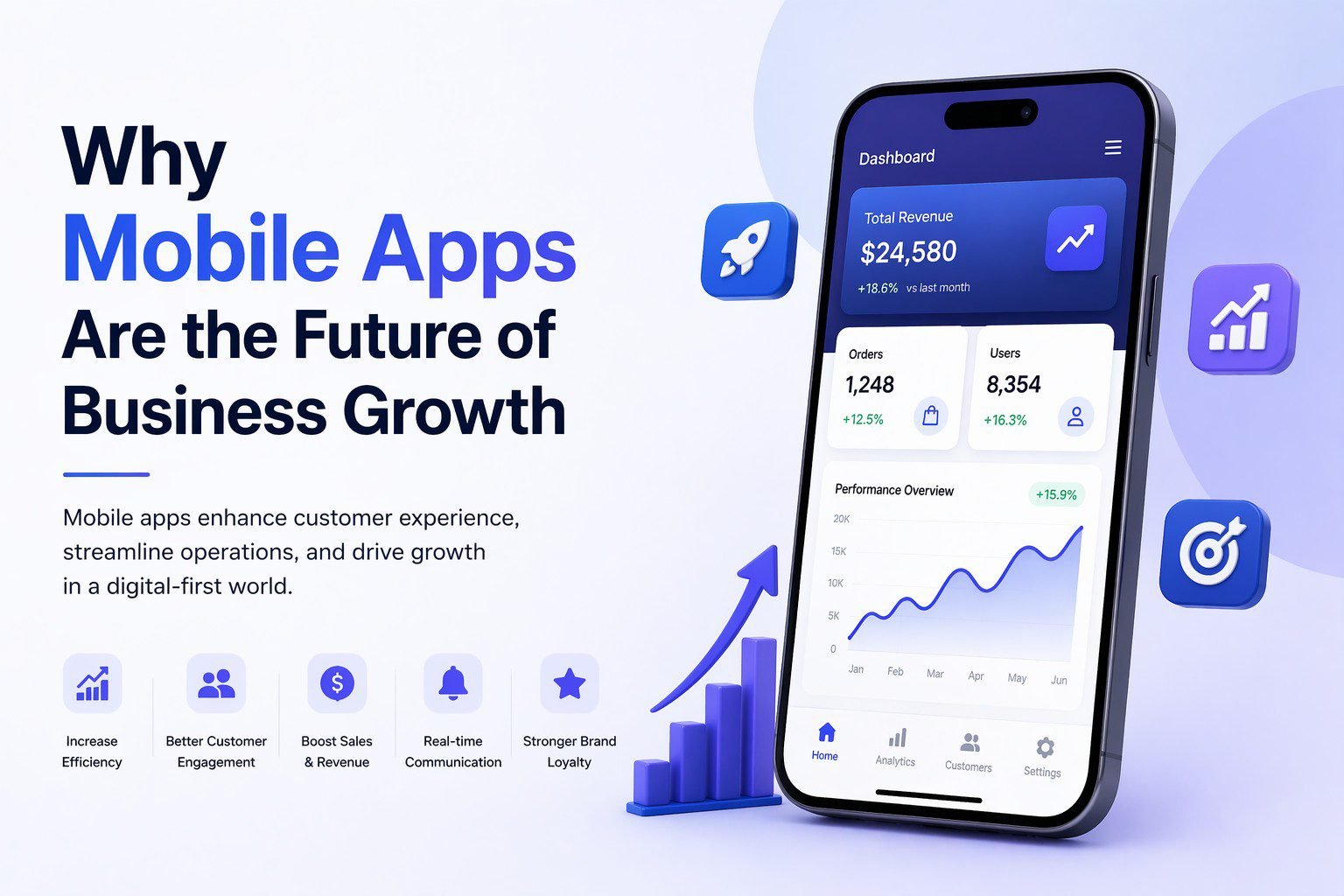
Mobile apps for business growth are no longer a future concept. They already define how modern users interact with brands daily. Many businesses today feel stuck despite having websites and active marketing channels.
The issue is not visibility anymore. Instead, it is engagement and consistency. Users expect faster access, smarter experiences, and interactions that feel effortless.
That expectation changed how digital ecosystems function. Businesses that rely only on websites often miss repeated engagement opportunities.
Apps quietly solve this gap. They stay on the device, remember behavior, and bring users back without effort.
- Mobile apps create direct and repeat customer interaction
- They improve retention more than websites alone
- Revenue grows through faster and simpler user journeys
- Apps strengthen long term brand connection
- Execution and strategy decide real success
Table of Contents
- The Shift from Browsing to Interaction
- Why Mobile Apps Improve Customer Retention
- Revenue Impact and App Driven Growth
- Real World Usage Scenario
- Success Story
- Where Businesses Go Wrong
- Role of Development Partners
- User Reviews
- Forum Discussions
- FAQs
- Conclusion
The Shift from Browsing to Interaction
Earlier, users explored websites and moved on. The interaction was temporary and often transactional. However, user behavior evolved significantly over the past few years.
Today, users prefer platforms that stay connected with them. Apps enable continuous engagement instead of one time visits. This shift changed how businesses measure success.
Digital transformation apps now shape how brands interact with customers. They create a loop where users return naturally without repeated marketing push.
That behavioral change explains why apps feel more personal than websites. They turn interaction into a habit.
Why Mobile Apps Improve Customer Retention
Retention remains one of the most important factors in business growth. While attracting users is achievable, keeping them engaged requires consistency and ease.
Apps improve retention through features like notifications and personalization. They remind users at the right time and provide relevant experiences.
Users rarely revisit websites regularly. However, they open apps frequently without thinking much about it.
This difference in behavior directly impacts growth. Mobile apps for business growth strengthen long term engagement without constant acquisition costs.
Revenue Impact and App Driven Growth
Revenue improves when user journeys become shorter and simpler. Apps reduce friction in transactions and improve conversion rates.
Features such as saved payments and quick navigation help users complete actions faster. As a result, businesses see better performance without increasing traffic.
App driven revenue also benefits from repeat usage. Frequent interaction increases purchase probability naturally.
Scalable business apps focus on making every interaction efficient. That efficiency directly translates into growth.
Real World Usage Scenario
A mid sized retail business relied on website traffic for sales. They had steady visitors, but conversions stayed inconsistent over time.
After launching an app, engagement started improving gradually. Users who installed it returned more often through notifications and easier browsing.
Repeat purchases increased without major marketing changes. The product stayed the same, but the experience improved.
This scenario reflects how mobile apps for business growth work in practical environments.
Success Story
A service based company struggled with declining conversions. Their website traffic remained stable, but engagement dropped steadily.
They introduced a simple app focused on booking and reminders. The app reduced effort for users and improved interaction clarity.
Over time, retention improved significantly. Customers returned without requiring heavy marketing campaigns.
The change came from accessibility rather than expansion. Better access created better results.
Where Businesses Go Wrong
Many businesses assume building an app guarantees success. However, the outcome depends on strategy rather than just development.
Some apps lack purpose and fail to offer value beyond the website. Others try to include too many features, which reduces usability.
User experience also plays a critical role. Slow or confusing apps lead to quick uninstalls.
Without clear direction, apps become unused assets instead of growth drivers.
Role of Development Partners
Execution quality determines whether an app succeeds or fails. A well designed app feels natural, while a poorly built one creates friction.
Working with the right partner helps align the app with business goals. Companies like Mobile App Developer focus on product strategy along with development.
Integration with marketing channels also improves results. Strategies like social media marketing help drive initial adoption and engagement.
Forward looking businesses also explore emerging ecosystems. For instance, web3 development company in Switzerland supports future ready digital strategies.
User Reviews
Rahul Mehta, Mumbai
We were unsure about building an app initially. However, once launched, customer engagement improved without increasing advertising efforts.
Ananya Sharma, Delhi
Our website worked well, but engagement stayed limited. The app improved interaction speed and made the experience more personal.
James Carter, London
We built an app for convenience. Over time, repeat purchases increased and customer loyalty improved naturally.
Forum Discussions
Question by Vikram Singh, Chandigarh
Do small businesses benefit from apps or is this only for large companies?
Community Reply by Neha Verma, Bangalore
It depends on user interaction frequency. If customers engage often, apps help regardless of business size.
Question by Arjun Patel, Ahmedabad
What if users do not download the app after launch?
Community Reply by Rohan Gupta, Pune
Adoption depends on value. If the app improves convenience, users gradually start using it.
FAQs
Are mobile apps necessary for every business today?
Not every business requires an app immediately. However, businesses with frequent user interaction benefit significantly from having one.
How do mobile apps improve business growth?
They improve retention, reduce friction in transactions, and create direct communication channels that increase engagement and conversions.
Is app development expensive for small businesses?
Costs depend on features and complexity. Starting with a focused solution is often more effective than building a large system.
Why do users keep certain apps installed?
Users keep apps that provide consistent value, save time, and simplify daily actions through personalization and ease of use.
How should apps and websites work together?
Websites help with discovery, while apps focus on engagement and retention. Both should work together as part of a complete strategy.
Conclusion
Mobile apps changed how businesses connect with users. They are no longer optional tools but essential components of modern growth strategies.
Businesses that focus on engagement rather than just reach see more consistent results. Apps support that shift by creating stronger and more direct connections.
The future of business growth depends on how well companies adapt to user behavior. Apps are simply the most effective way to align with that change.






Leave a Reply