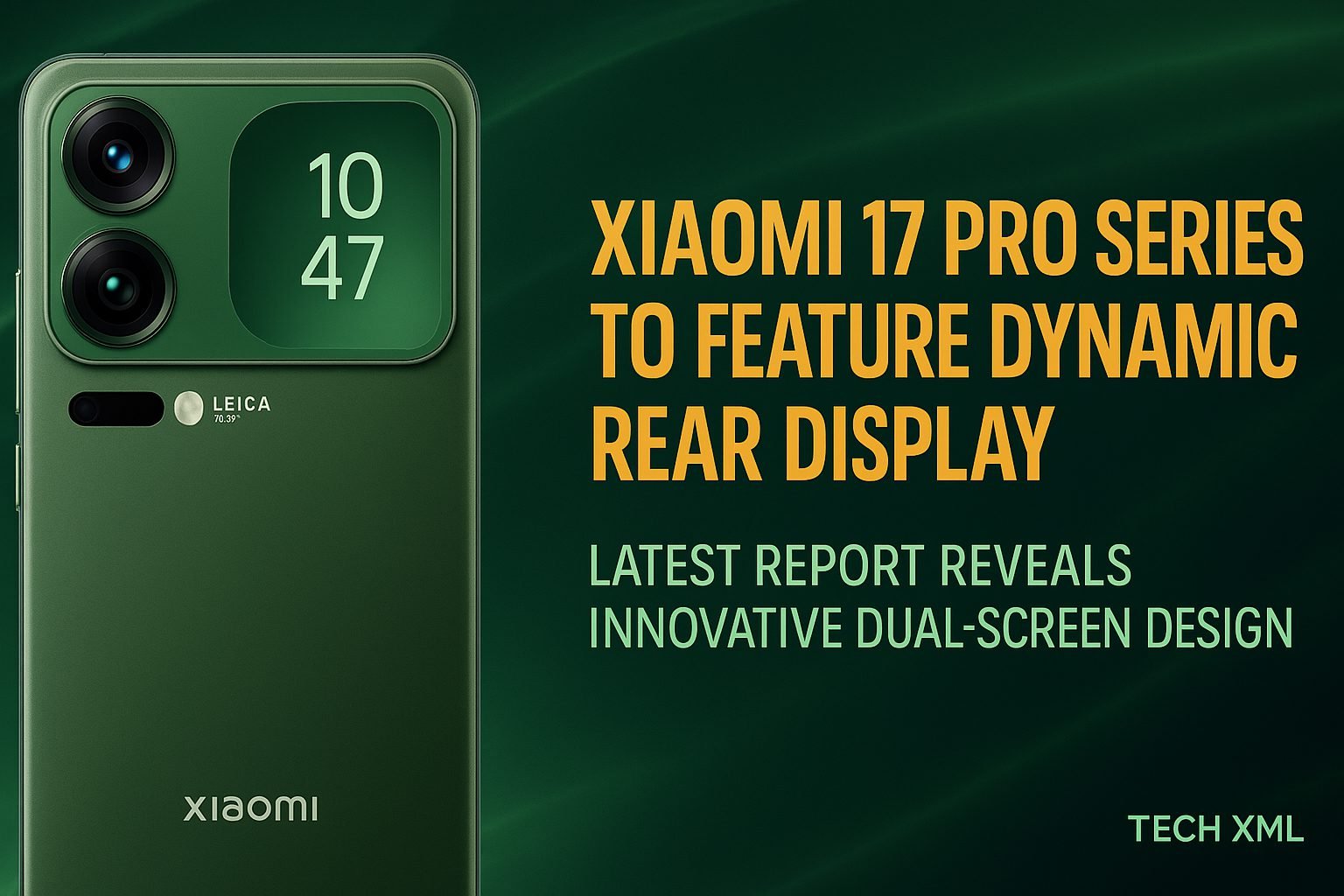
The smartphone world is abuzz today as fresh rumors suggest the Xiaomi 17 Pro Series will introduce a Dynamic Rear Display. A bold move that could reshape design expectations in 2025. As premium phones race toward new boundaries, Xiaomi appears ready to raise the bar again. From control panels on the back to live notifications that greet you without flipping the phone, this rumored feature may become a turning point in how users interact with their devices.
From curved edges and rotating lenses to under-display cameras, smartphone design has been evolving at breakneck speed. Yet most flagships still stick to a static rear glass plate. The concept of a secondary screen on the back has flirted with niche devices and foldables. Xiaomi’s alleged leap with the Xiaomi 17 Pro Series could bring that concept into mainstream flagship territory, blending practicality with spectacle. Today, we dig into what this dynamic display might deliver, the challenges Xiaomi must overcome, and how it may shape Android flagship trends for the year ahead.
What Is This Dynamic Rear Display?
The rumors point to a secondary screen embedded into the rear panel of the . A high-resolution, perhaps AMOLED panel that can show context-aware visuals. Think of it as a mini dashboard on your phone’s back. Potential uses include:
- Always-on clock, date, and weather widgets
- Notification previews (messages, emails, calls)
- Camera viewfinder for rear camera selfies
- Customizable shortcuts and app widgets
- Music controls, timer, battery status
This rear display wouldn’t replace the main screen. Rather, it complements it. In many scenarios, users may glance at the back display instead of turning the device around saving time, battery, or simply making interactions feel smoother.
A credible leak claims that Xiaomi is already in talks with app developers to support rear display widgets. Integration with MIUI is expected to allow users to toggle what shows on the back, and possibly to schedule display “themes” for day vs night modes.
How It Could Enhance Everyday Use
Here’s where the magic might truly lie. Below are several practical ways the Xiaomi 17 Pro Series rear display might shine:
1. Notification Glance Without Disruption
Instead of flipping your phone, you could see the latest alerts on the back. When the phone is face down on a desk, the rear display could show essential alerts. That saves you a glance.
2. Rear Camera Selfie Mode
Want a high-quality selfie with your best camera? The back screen could act as a live preview. You set pose, see image framing, press shutter. That’s far better than relying on the front camera or guessing with the back camera blind.
3. Custom Widgets & Controls
You might assign always-on widgets like media controls, calendar events, step count, or smart home toggles to the rear. Quick toggles to flashlight, QR scanner, or screen recording could be one tap away on the back.
4. Battery & Device Status
A subtle battery meter, network signal bars, or temperature reading might live there. No need to wake the front to see battery or other system info.
5. Thematic & Interactive Visuals
Users who like flair could animate wallpapers or light effects on the back panel. Live visuals, reactive lighting, or even notification animations could lend a futuristic edge.
By turning the back into a dynamic zone, the Xiaomi 17 Pro Series might shift how we think about “front vs back” user experience.
Balancing Novelty and Practicality: Key Challenges
Launching such a feature is not without hurdles. Xiaomi must navigate the following concerns if this is to be a polished, worthwhile addition rather than a gimmick.
Power Efficiency and Battery Drain
Driving a display is expensive in power terms. The rear screen must be efficient—perhaps low refresh, partial refresh, or always-on modes tuned for minimal consumption. Xiaomi may leverage underutilized hardware or adopt intelligent pixel refresh to reduce draw.
Durability and Structural Integrity
Embedding a second display into the back glass or composite adds complexity. Xiaomi has to ensure the back remains robust, scratch resistant, and structurally sound—especially during drops. Repairability will matter too.
Software & App Optimization
If apps don’t support the rear display, the feature risks being hollow. Xiaomi must provide APIs and incentives for developers to build rear widgets or adapt content layouts. That requires tight software collaboration.
Heat Dissipation
Two active screens could increase thermal stress. Xiaomi must preserve performance and manage heat flow inside the chassis so the rear display does not cause throttling or discomfort.
Seamless Transition and UX Consistency
Switching between front and rear experiences needs to feel natural. Animations, context awareness (e.g. auto disable when in pocket), and user settings must be intuitive. If users find it confusing, adoption may falter.
Price and Cost Tradeoffs
Incorporating a second display will raise component and assembly cost. Xiaomi must ensure users see enough value to justify any premium price uptick.
Placing It in the Broader Dual-Screen / Foldable Landscape
Xiaomi is not inventing the concept of multiple displays. But how the Xiaomi 17 Pro Series employs dual screens will distinguish it.
Comparison with Foldables and Dual Screen Devices
- Foldables (like Galaxy Z series) hinge a central display but typically don’t use a separate rear display.
- Devices with detachable covers or second displays (LG V series, YotaPhone concept) have tried, but with limited success.
- Asus’ dual-screen accessories remain niche.
What sets the Xiaomi approach apart is integration into a conventional flagship form factor. If done well, it may offer a middle path: more interactivity than a standard phone without the bulk or fragility of foldables.
How It Stands Against Mainstream Rivals
While competitors push under-display cameras, variable refresh rates, and periscope telephotos, Xiaomi may differentiate via experiential innovation. A working dynamic rear display could spark a new design arms race others may scramble to match.
However, success depends on execution. A half-baked version would attract criticism. Most users judge usability, battery, reliability.
Possible Specs & Technical Expectations
Though no official specs exist, leaks and logical assumptions give us a likely picture:
- Display type: AMOLED or OLED, flexible panel
- Refresh rate: 60 Hz or adaptive (maybe 30 Hz or lower in standby)
- Resolution: modest (e.g. HD range) to balance power
- Touch support: possibly limited to single touch or taps
- Brightness: sufficient to see in ambient light (e.g. 300–400 nits)
- Size: a narrow strip or square area, not full-back screen
- Integration with main OS: MIUI + dedicated rear layout engine
- Material layering: Gorilla Glass, sapphire, or composite to protect the panel
We expect that Xiaomi will calibrate performance so the rear display acts more like a smart notification panel than a second full browser.
Rumored Xiaomi 17 Pro Series Features (Beyond Rear Display)
Reports also suggest the Xiaomi 17 Pro Series features may include:
- Upgraded camera system, perhaps with larger sensors and improved telephoto
- New processing platform, possibly Snapdragon next generation
- Faster charging, e.g. 120 W wired or advanced wireless
- Enhanced cooling and thermal design
- Sleek design refresh, thinner bezels, improved haptics
The dynamic rear display may be the headline, but the rest of the package matters for adoption.
Why This Matters for Xiaomi Fans & Tech Enthusiasts
For those closely watching Xiaomi’s flagship trajectory, this move indicates boldness. Rather than iterating part by part, Xiaomi may be betting on experiential innovation to define its leadership in 2025.
If successful, the Xiaomi 17 Pro Series leak about rear display could spark:
- Elevated brand perception: Xiaomi as a design innovator
- Increased media attention and hype
- Copycat efforts from competitors
- New use cases and UX paradigms
For early adopters, owning a phone with such a standout feature becomes a statement. For reviewers, it offers fresh ground to analyze, test battery, durability, and software cohesion.
Potential Use Cases: A Mini-Story
Consider this scenario with a tech journalist, Meera, reviewing the Xiaomi 17 Pro:
Meera is filming a video at her desk. Her phone rests face down. Mid-shoot, she hears a message notification. Instead of flipping the phone or glancing at her wrist, she glances down and sees the message preview on the rear display. She taps to open the camera widget and selfies with the rear cam, ensuring her framing is perfect, without disrupting her shoot. Later, she taps on the music widget behind to skip tracks. Her battery drops a little faster than usual, but her excitement outweighs the tradeoff. She tweets about this immersive back-panel experience and garners engagement from fellow smartphone fans.
In this way, the rear display becomes part of her flow, not a gimmick she disables.
Limitations & What Might Disappoint
Despite the ambition, some users may find:
- Minimal benefit if only simple widgets are supported
- Incompatibility with many third-party apps at launch
- Battery drain concerns in heavy usage
- Display wear or ghosting over time
- Fragility: scratch or damage risk
If Xiaomi positions the feature as optional, letting users disable or minimize it, that flexibility could mitigate criticism.
Can the Dynamic Rear Display Elevate the Flagship Experience?
Yes! but only if executed with finesse. The rear display must feel seamless, reliable, power efficient, and genuinely useful. It should not be a feature one immediately turns off. Xiaomi’s mixed track record with ambitious features suggests risk. But with MIUI’s maturity and hardware strengths, there’s potential.
If the rear display proves successful, it could:
- Spur rivals to adopt secondary displays
- Influence design direction across 2025 and beyond
- Redefine how we think about front & back interactivity
Ultimately, the Xiaomi 17 Pro Series needs to pair novelty with consistent daily value. If it does, it may become a landmark smartphone, not just a headline.
Read More-
- ASUS ROG Ally Series Debuts in India: Full Specs and Pricing
- Red Magic 11 Pro Series Launched With Snapdragon Elite Gen 5
- ASUS ROG Ally Series Debuts in India: Full Specs and Pricing
- Top 10 Smartwatches To Grab This Diwali Sale 2025
- Pixel 10 Pro Fold Explosion Raises Questions About Durability
User Reviews
Rahul Sinha – Bengaluru
The Xiaomi 17 Pro Series looks stunning. The Dynamic Rear Display could actually be useful if Xiaomi gets battery efficiency right. I’m genuinely excited to try it.Neha Kapoor – Gurugram
I love Xiaomi’s design experiments, and this rear display idea feels fresh. If it supports camera previews and music widgets, I’m definitely buying it.Karan Mehta – Pune
As a content creator, the Dynamic Rear Display sounds perfect. Shooting videos using the rear camera preview will save time and make framing easier.
Forum Discussions
Thread 1 – “Will It Be Practical?”
Aakash (Mumbai): Looks cool, but I hope it’s not just for show.
Ritika (Kolkata): True! It needs good app support to feel useful.
Vikrant (Delhi): If Xiaomi nails the software, this could be the next big trend.Thread 2 – “Better Than Foldables?”
Manish (Chandigarh): I prefer this over foldables—simpler and lighter.
Priya (Hyderabad): Same here! Rear screen feels more practical for daily use.
Raj (Jaipur): If visibility outdoors is good, Xiaomi might win this round.
Frequently Asked Questions (FAQ)
Q. Will the dynamic rear display always be on?
Probably not. Xiaomi may allow always-on mode with low refresh and selective brightness. Users may also schedule when it activates (e.g. only during daytime or when notifications arrive).
Q. Can any app use the rear display?
Xiaomi likely will offer APIs so third-party apps can build support. But at launch, only core apps and selected partners may fully leverage it.
Q. Will it impact battery life significantly?
Yes, to some degree. But Xiaomi could mitigate the drain with partial refresh, low refresh states, and optimized power management.
Q. Is this concept completely new?
No. Earlier devices and concept phones (such as dual display phones) experimented with back screens. But none integrated into mainstream flagships with polished software. This may be the first practical iteration.
Q. Is it just for show?
It depends on execution. If it offers meaningful shortcuts, glanceable info, and useful camera utility, it may evolve into a core feature rather than a gimmick.
Conclusion
The Xiaomi 17 Pro Series, with its reported Dynamic Rear Display, could be a watershed moment in flagship smartphone design. It embodies Xiaomi’s identity as a brand that experiments and pushes boundaries. If gifted with thoughtful software, efficient power use, and durable hardware, this rear display may move from novelty to indispensable.
Yet the stakes are high. Missteps in battery, user experience, or robustness could render it a flashy footnote. For Xiaomi fans and smartphone enthusiasts, the anticipation is real. We await confirmation, specs, and real-world testing. But at this moment, Xiaomi may just be one bold reveal away from nudging the smartphone world into a new era.






Leave a Reply