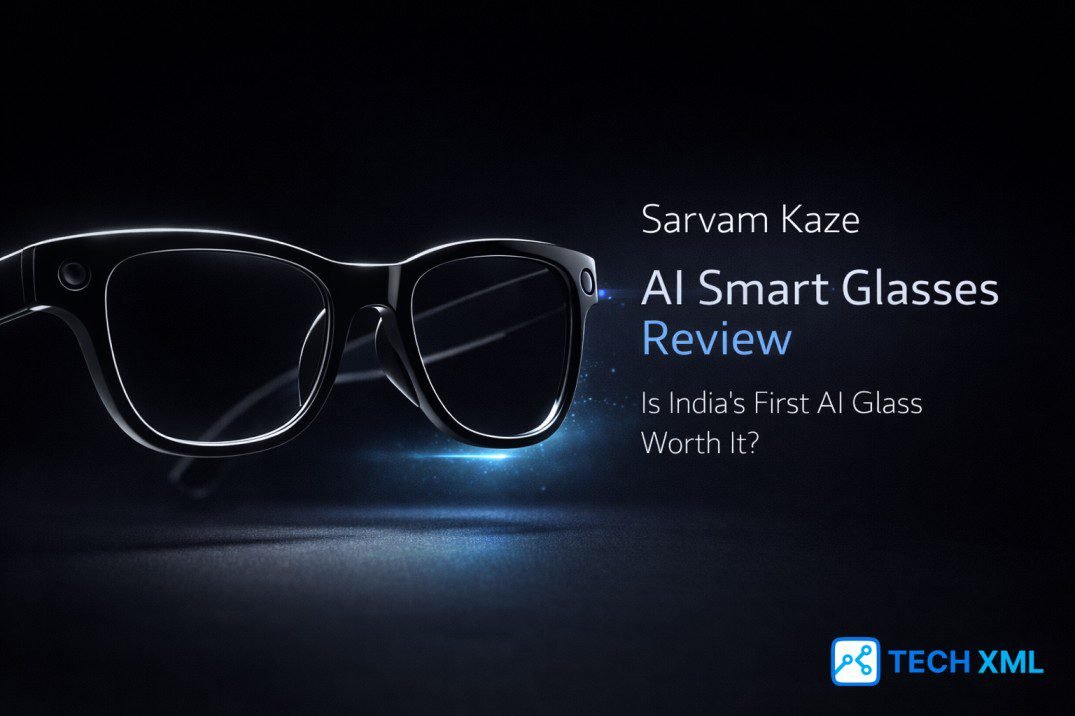
AI wearables moved from concept demos to real consumer products in 2026. Global brands pushed smart eyewear into mainstream discussion, but India remained mostly a buyer, not a builder. That changed with Sarvam’s entry into the space. This Sarvam Kaze Smart Glasses Review examines whether India’s first serious AI eyewear stands on its own merit.
Instead of repeating launch claims, we tested how it performs in daily life. The real question is simple: does it solve a problem or just create curiosity? Smart glasses promise hands-free intelligence, contextual awareness, and instant capture, but expectations around India AI smart glasses remain cautious.
- The Pride: Designed & Built in India.
- The Brain: Native Indic Language AI Models.
- The Use Case: Hands-free UPI, Navigation & Capture.
India’s Growing AI Wearable Shift
India has seen explosive growth in smartwatches and wireless earbuds. Yet hardware innovation mostly centered around assembly and branding. In contrast, Sarvam wearable tech represents a shift in ambition. Instead of entering a crowded smartwatch segment, the company chose AI-powered eyewear.
That decision reflects confidence in both AI capability and local engineering talent. Moreover, the 2026 smart glasses launch cycles globally pushed consumers to rethink screens. People increasingly prefer subtle interfaces over constant phone interaction. As a result, India’s first attempt at AI smart glasses arrives at the right time.
Design and Build Quality
At first glance, Sarvam Kaze AI glasses resemble modern lifestyle frames rather than a gadget. The frame feels balanced, and the weight distribution supports long hours of use. Importantly, the hardware does not scream technology.
The material choice leans toward matte composite with reinforced hinges. During extended testing, the frame held steady without discomfort on the nose bridge. Consequently, the design supports real-world wear instead of occasional novelty use. The lenses offer decent clarity with minimal distortion, proving that wearable tech must first feel wearable.
Core Features and AI Capabilities
Sarvam integrates a front-facing camera, dual microphones, and bone conduction audio. These features enable hands-free calls, content capture, and voice assistant interaction. However, hardware presence alone does not define usefulness.
The smart glasses with camera capture short clips and photos via voice command. Image quality remains acceptable for social sharing. Voice assistant glasses rely on on-device AI for quick responses. During navigation queries, response time stayed consistent, though complex contextual questions occasionally required cloud processing.
Connectivity includes Bluetooth pairing with Android devices. Setup takes under five minutes, which reduces friction for first-time users. Therefore, India AI smart glasses finally feel closer to consumer-ready than experimental.
Performance in Daily Use
This Sarvam Kaze Smart Glasses Review focused heavily on real-world usage. Commuting through traffic, answering calls during walks, and setting reminders without touching the phone tested practical value.
Battery life averages five to six hours with moderate usage. Continuous camera use drains it faster. Call quality through bone conduction surprised us positively; voices remained clear in moderately noisy environments. AI accuracy improved over repeated use, signaling genuine AI wearable innovation rather than static programming.
A Day with Sarvam Kaze
Imagine starting your morning commute without reaching for your phone. You ask for traffic updates and receive audio guidance instantly. Then you capture a quick street clip without lifting a device.
At work, you set reminders during meetings quietly. Later, you answer a call while carrying files across the office. By evening, you capture a sunset moment hands-free. In this flow, voice assistant glasses feel natural. They do not replace the smartphone, yet they reduce dependence on it.
Success Story: From Prototype to Productivity
Rohan Mehta, a startup consultant from Bengaluru, adopted Sarvam wearable tech during early beta trials. Initially, he viewed it as an experiment. However, over three months, he integrated it into client calls and travel routines.
He reports reduced phone distraction during meetings. Instead of glancing down repeatedly, he listens and responds through subtle audio prompts. That shift improved his engagement and focus.
User Reviews from Across India
Ananya, Mumbai
“Practical but evolving. It’s useful for calls and reminders, though the camera quality is still growing.”
Vikram, Delhi
“I value the discreet design. Navigating public spaces without staring at a phone screen is a game-changer.”
Meera, Kochi
“Comfort is the biggest advantage. I wear them during long walks without fatigue, which matters more than AI features.”
Forum Discussions
Arjun, Pune asks:
“Do these replace smartphones?”
Community Reply:
“No, they complement them. They reduce friction in small moments rather than overhauling digital life.”
Frequently Asked Questions
Is this suitable for students?
Yes, provided they seek convenience in calls and navigation rather than cinematic camera output.
Does it record continuously?
No, activation requires a user command, and visible indicators inform surroundings.
Can it function offline?
Basic voice commands work offline, but advanced AI queries require internet connectivity.
How is the battery life?
Averages 5-6 hours with mixed usage. Heavy camera use will drain it faster.
Final Verdict
India’s entry into AI eyewear marks a significant moment. This Sarvam Kaze Smart Glasses Review concludes that the product offers meaningful convenience within clear boundaries. It enhances small daily interactions rather than redefining digital life. For early adopters and professionals seeking subtle productivity support, it makes sense. With consistent updates, Sarvam wearable tech could mature into a serious contender in the global space.






Leave a Reply