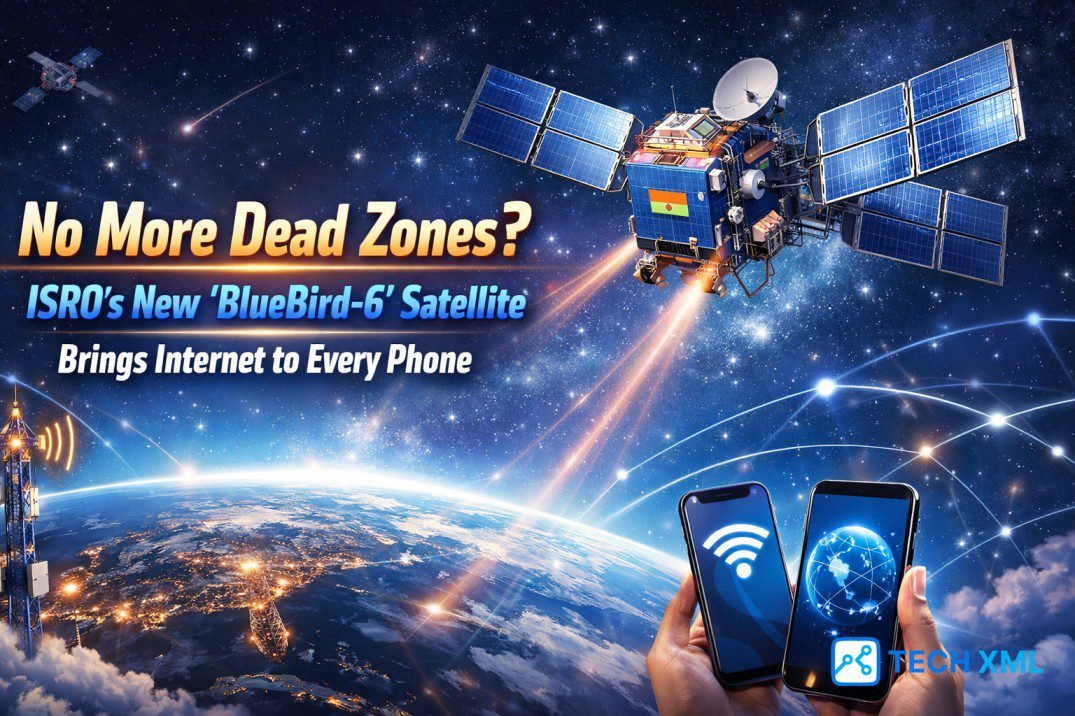
You step outside city limits, open your phone, and suddenly everything slows down or stops. Maps fail to load, calls drop, and even basic payments become unreliable. Despite living in a highly connected world, mobile networks still collapse the moment infrastructure thins out. BlueBird-6 satellite internet enters this gap with a different promise. It does not chase higher speeds or flashy upgrades. Instead, it focuses on a more basic problem: keeping smartphones connected when ground networks disappear entirely.
This idea naturally raises questions. Can a satellite really support an ordinary smartphone without towers, dishes, or special hardware? And more importantly, does it solve real problems or just sound impressive on paper? Understanding this matters because connectivity is no longer optional. It supports safety, navigation, coordination, and everyday decision making.
In this Guide:
BlueBird-6 Satellite Internet in Simple Words
BlueBird-6 satellite internet is designed to prevent complete signal loss when mobile towers are unavailable. It activates only in situations where your phone cannot connect to a ground-based network. In normal city usage, it stays inactive.
This system is not meant to replace broadband or high-speed mobile data. Its role begins exactly where traditional infrastructure fails. Remote regions, disaster zones, highways, oceans, and border areas define its purpose. Instead of sending signals from towers on land, the satellite functions like a mobile tower placed in space. Communication still follows cellular standards, which means existing smartphones can participate without hardware changes.
The Core Problem This Satellite Is Trying to Fix
Modern mobile networks depend heavily on physical infrastructure. Towers must be installed, powered, maintained, and protected. Geography often limits where this infrastructure can exist. Mountains, dense forests, deserts, and oceans make tower placement impractical. Even where towers exist, power failures and weather damage can take entire regions offline. Natural disasters amplify this weakness. BlueBird-6 satellite internet targets this exact vulnerability. It does not attempt to outperform existing networks. It ensures they are not the only option.
Why Smartphones Are the Real Focus This Time
Smartphones are the primary communication tool for most people. During emergencies or travel, users do not carry routers, antennas, or specialized devices. Direct-to-phone connectivity removes friction entirely. Users continue using their existing smartphones without accessories, configuration, or behavior changes. This simplicity matters. Technology adoption depends less on capability and more on usability. By centering smartphones instead of equipment, this approach shifts satellite connectivity from niche to practical.
The Technology Behind BlueBird-6 Explained Clearly
When a phone searches for a network and finds no nearby tower, it normally displays no service. With BlueBird-6, the phone can instead connect to a compatible satellite overhead. The satellite receives the phone’s signal and routes it to ground gateways connected to the wider internet. Responses travel back along the same path. As satellites move across the sky, connections switch automatically. This process feels similar to tower handovers during travel and requires no user action.
Low Earth Orbit and Why Distance Matters
Earlier satellites orbited far from Earth, which weakened signals and increased delay. Smartphones could not reliably communicate across that distance. BlueBird-6 operates in low earth orbit, significantly closer to the planet. This reduced distance allows normal smartphone antennas to maintain usable communication. Lower orbit also reduces latency. While still higher than city networks, performance remains suitable for essential communication. Distance is the key technical shift that makes direct connectivity feasible.
How a Satellite Acts Like a Mobile Tower
In functional terms, the satellite behaves like a base station. It listens for phone signals, authenticates connections, and manages data flow. Phones transmit low-power signals upward. Large satellite antennas receive these signals and forward data through space to ground infrastructure. The round trip happens continuously, but the user experiences only stable access. Coverage expands without constructing physical towers. The network extends upward rather than outward.
What Makes BlueBird-6 Different From Older Satellite Internet
Older satellite internet systems required bulky terminals and fixed installations. Direct phone connectivity was never part of their design. These systems prioritized homes, ships, or remote offices, not moving users. Mobility remained an afterthought. BlueBird-6 reverses that assumption. It designs the network around movement, unpredictability, and real-world phone usage. This shift explains why earlier approaches failed on smartphones and why this one appears viable.
Why Traditional Satellite Internet Never Worked on Phones
Distance prevented reliable communication. Smartphone antennas could not sustain links to high-orbit satellites. Latency made everyday usage frustrating. Connections dropped frequently, and performance felt inconsistent. The experience never aligned with mobile expectations. As a result, adoption remained limited. BlueBird-6 satellite internet addresses these limitations through orbit choice and network design.
What Changed With Modern Space Technology
Advances in satellite engineering allow stronger and more focused signals. Ground systems handle routing and load balancing more efficiently. Software-defined networks enable smooth handovers without user intervention. Phones remain unaware of network transitions. These changes collectively make direct-to-phone satellite connectivity practical rather than experimental.
Real Places Where BlueBird-6 Can Make the Biggest Impact
Urban areas already benefit from dense networks and redundancy. The real impact appears elsewhere. Remote regions often rely on a single tower. When it fails, communication disappears entirely. Satellite connectivity fills these gaps quietly. It does not compete with existing networks. It supports the spaces they cannot reach. The result is subtle but meaningful. Silence turns into access.
Rural Regions and Network Blackouts
Power cuts and maintenance issues frequently disrupt rural networks. Connectivity can vanish without warning. Satellite access provides consistency. Even basic messaging and alerts improve safety and coordination. In these areas, reliability matters more than speed. That is where this system delivers value.
Travel Routes, Border Areas, and Emergency Situations
Highways often pass through long dead zones. Breakdowns become risky without communication. During disasters, towers fail first. Satellite connectivity enables coordination when time is critical. In remote travel zones, phones remain functional without additional equipment.
Read more on Tech XML:
- Wait! Don’t Buy the S25: Samsung Galaxy S26 Launch Delayed to February [New Leaks]
- Make Movies Instantly: Google Veo 3.1 is Here! 5 Features That Blow Sora Away
- Android 16 First Look: 5 Features That Will Make Your Old Phone Feel New
- Robots Are Coming: How Amazon’s New “Agentic AI” Fleet Will Change Your Delivery
- Update Now: Microsoft Patches 56 Critical Security Flaws in December 2025
Practical Expectations From BlueBird-6 Satellite Internet
This system does not aim to support heavy streaming or high-speed downloads. Availability defines its strength. Users can expect messaging, navigation, and essential app access. Performance remains stable rather than fast. Clear expectations prevent disappointment. Presence matters more than performance in these scenarios.
Internet Speed, Latency, and Daily Usage Reality
Latency remains higher than ground networks, but everyday communication stays usable. Speeds prioritize stability across wide regions. The system balances many users simultaneously. Environmental factors such as weather and satellite positioning influence performance.
Battery Usage and Device Compatibility Concerns
Satellite communication may consume more battery than tower-based signals. Activation typically occurs only when no ground network exists. Most modern smartphones already support the necessary radio standards. Actual availability depends on software and carrier support. Rollouts will be phased rather than immediate.
Case Study: Connectivity During a Complete Network Failure
After severe flooding in a coastal region, mobile towers lost power within hours. Communication collapsed quickly. Satellite connectivity allowed basic messaging and location sharing to continue. Rescue teams coordinated movements despite infrastructure failure. Families received reassurance instead of silence. Connectivity reduced uncertainty during crisis. This illustrates the true value of the system.
User Reviews: What Early Observers Think
Sandeep Mehta, Jodhpur
“I value reliability during long highway travel. For me, emergency connectivity matters more than speed.”
Anjali Rao, Coimbatore
“Consistency without additional hardware feels practical, especially during frequent rural outages.”
Farhan Khan, Leh
“Satellite access is a major safety improvement in remote terrain like ours.”
Forum Discussion: Real Questions People Are Asking
Ritu Malhotra, Indore:
Will there be clarity on pricing and data limits? Cost transparency remains important.
Joseph Mathew, Alappuzha:
What about privacy? Users expect satellite networks to meet existing security standards.
Frequently Asked Questions About BlueBird-6
Will BlueBird-6 work on my current phone?
It is expected to work on most modern smartphones, depending on software updates and carrier agreements.
How much will satellite access cost?
Satellite access may integrate with existing mobile plans, though pricing models will vary by operator.
Is satellite communication secure?
Security follows cellular encryption standards, making implementation quality more important than the medium.
When will the service be available?
Service availability depends on testing, approvals, and phased rollout.
Does this replace mobile towers?
No, satellite connectivity will complement mobile towers rather than replace them.
Final Perspective: What BlueBird-6 Really Means for Mobile Connectivity
BlueBird-6 satellite internet does not promise perfection. It promises presence. Where silence once dominated, basic connectivity can now exist. This change is not dramatic, but it is meaningful. Future networks will be layered. Towers will serve cities, fiber will power homes, and satellites will protect the edges. In that context, reliability becomes the real upgrade.






Leave a Reply