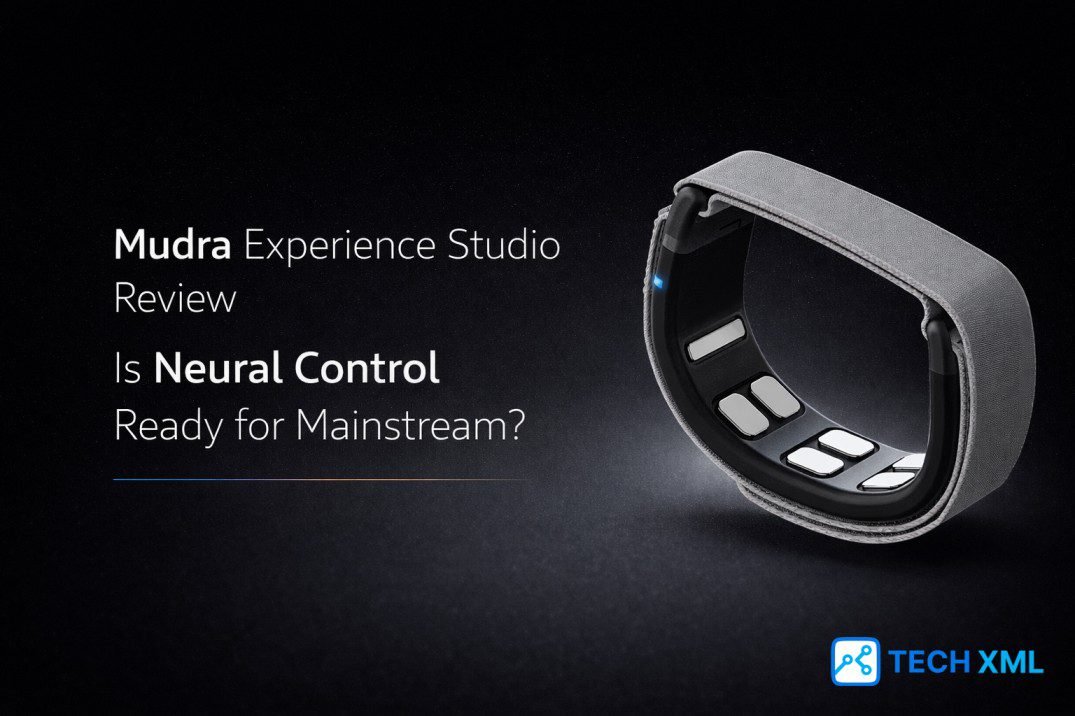
In 2026, input technology sits at a turning point. Touchscreens feel mature, voice commands feel situational, and gesture tracking still struggles with precision in dynamic environments. Meanwhile, neural control claims to reduce friction by translating subtle muscle signals into digital commands. This Mudra Experience Studio Review looks beyond headlines and controlled demonstrations.
It examines whether neural gesture control has evolved into something dependable, or whether it remains a carefully staged preview of the future. The distinction matters because spatial computing devices now demand new forms of interaction.
- The Tech: Surface Nerve Conductance (SNC) Wristband.
- The Magic: Control AR/VR with micro-finger movements.
- The Reality: Incredible precision, but requires calibration.
The Industry Shift to Neural Input
The broader industry shift explains why this conversation feels urgent. As immersive headsets and lightweight XR hardware improve, traditional hand tracking shows its limits. Cameras lose context in low light, and air gestures lack consistent micro-precision. Consequently, wearable neural interface systems aim to bypass optical dependency altogether.
Developers now experiment with brain-computer interface (BCI) layers that interpret electrical signals from wrist-level nerve activity. While this sounds complex, the goal remains simple: enable hands-free interaction without exaggerated arm movement. If that works reliably, it could redefine human-computer interaction across industries.
What the Studio Actually Demonstrates
The Mudra Experience Studio presents a structured environment. Users wear a wrist-based neural band connected to a spatial computing device. After a short calibration phase, the system maps subtle finger intent into digital commands.
During my session, the interface responded to micro-gestures rather than visible hand movements. A slight finger press activated menu selections. A controlled pinch motion triggered scrolling. The experience felt closer to muscle signaling than camera-tracked gestures.
Accuracy during calibration remained impressive inside the studio. The team adjusted signal sensitivity based on individual physiology. That personalization improved consistency, although it required focused setup time. Latency stayed low in controlled scenarios, with menu transitions occurring quickly and cursor movement feeling smooth.
Accuracy, Latency, and Learning Curve
Neural gesture control demands a short learning period. Unlike tapping a screen, users must understand how subtle finger tension translates into commands. Initially, the system misinterpreted a few gestures when I applied uneven pressure.
However, within twenty minutes, muscle memory started to form. The wearable neural interface responded more consistently as my movements became intentional and refined. That adaptation felt promising for repeated daily use.
Micro-precision remains the standout advantage. Instead of waving hands mid-air, I executed minimal finger contractions. This design reduces arm fatigue, which often affects extended XR sessions. As a result, human-computer interaction becomes less theatrical and more efficient.
Real World Usage Scenario
Imagine a product designer working inside an augmented workspace. The spatial computing device overlays 3D models onto a physical desk. Instead of reaching out for virtual buttons, the designer triggers commands through subtle finger contractions.
Scrolling through layers becomes discreet and fluid. Rotating a model requires a short calibrated gesture rather than a wide arm movement. This approach supports next-generation input expectations, especially in environments where precision matters more than spectacle.
In a presentation scenario, the benefits also appear clear. A speaker can advance slides without holding a remote or gesturing dramatically. The system allows natural posture while maintaining control. However, real-world settings introduce variables like background electrical noise and body movement, which may affect signal interpretation.
Case Study: Enterprise XR Design Lab
A Mumbai-based XR design lab integrated neural gesture control into its prototyping workflow. The team used a wearable neural interface paired with immersive design software. After two weeks, designers reported reduced arm fatigue during extended modeling sessions.
They appreciated the immersive tech experience because it felt less performative and more intuitive. As productivity stabilized, the lab reduced reliance on handheld controllers. Nevertheless, onboarding required structured training. New users needed guided calibration sessions to avoid frustration, succeeding because they operated in a controlled environment.
User Reviews
Rohit, Bengaluru
“Surprisingly precise. I expected exaggerated gestures but instead experienced subtle control. It captures a shift toward practical interaction.”
Ananya, Pune
“The wrist device is comfortable, and neural control felt natural after practice. I wonder how it performs during my commute.”
Daniel, Goa
“Low latency and minimal fatigue are great. But I’m cautious about pricing and consumer accessibility right now.”
Forum Discussions
Arjun, Hyderabad asks:
“Does this read my thoughts?”
Community Reply:
“No. It interprets muscle signals (motor intent) from the wrist, not cognitive data from the brain. It’s safe.”
Frequently Asked Questions
Is neural control safe?
Yes. Current systems passively read surface muscle signals (EMG/SNC) and do not transmit electricity into the body.
Is it ready for everyone?
It shows strong studio performance but requires calibration. It’s currently best for early adopters and enterprise users.
Better than hand tracking?
For precision and low light, yes. It doesn’t need cameras to see your hands, reducing fatigue.
Will it replace controllers?
Not entirely. Hybrid models will likely combine neural input for navigation with tactile devices for gaming.
Final Verdict
Neural input no longer feels like distant science fiction. Inside curated spaces, it delivers controlled, efficient interaction with minimal movement. That progress deserves recognition. This Mudra Experience Studio Review confirms that while mainstream readiness demands resilience outside ideal conditions, the trajectory is promising.
Until calibration becomes seamless and variability decreases, neural gesture control will remain strongest in professional environments. Readers seeking clarity can view neural control not as hype, but as a serious contender in the next chapter of immersive tech experience.


Leave a Reply