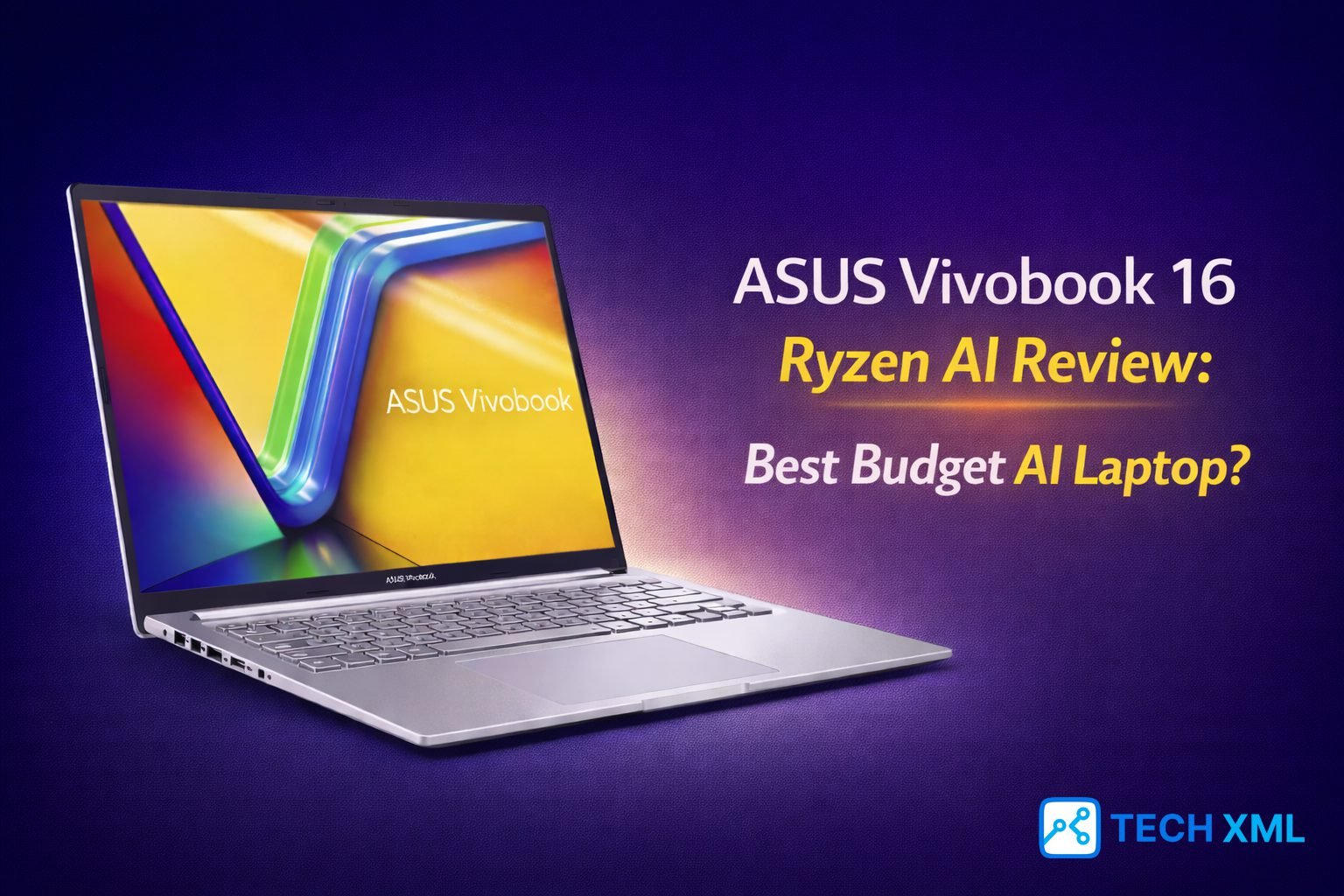
The AI laptop race in 2026 looks very different, making this ASUS Vivobook 16 Ryzen AI Review crucial for buyers who want intelligence on a budget. Brands no longer rely only on cloud-based tools to promote intelligence; instead, they highlight local processing and neural engines. That shift creates excitement, but it also creates confusion.
Many readers now ask a simple question: Does an affordable machine with AI branding truly improve daily productivity, or does it simply carry a modern label with limited impact? The Vivobook 16 enters a space once reserved for premium ultrabooks, positioning itself closer to mainstream buyers.
- The Brain: AMD Ryzen 8000 Series with NPU.
- The Gain: Faster local AI tasks (Blur, Denoise, Transcription).
- The Trade-off: Display is decent but not OLED-level.
The AI Laptop Landscape in 2026
Until recently, AI tasks mostly depended on servers. Image generation, transcription, and summarization all leaned heavily on internet connectivity. Now, Neural Processing Unit (NPU) laptop designs push certain tasks directly onto the device.
A Ryzen AI laptop 2026 model typically includes a dedicated NPU alongside the CPU and GPU. This architecture handles background blur, voice isolation, and lightweight generative tasks locally. As a result, latency drops and privacy improves.
However, not every AI badge guarantees meaningful performance gains. Some systems merely accelerate select applications. Therefore, evaluating a budget AI laptop demands clarity about real-world advantages.
Design and Build Quality
At first glance, the Vivobook 16 feels understated rather than flashy. ASUS chooses a clean chassis with subtle branding. The matte finish reduces fingerprints and keeps the device professional.
The 16-inch form factor gives it presence without becoming bulky. Although it is not an ultralight, it remains manageable for daily commuting. The hinge feels stable, and the keyboard deck resists noticeable flex. ASUS integrates a full-size keyboard with a numeric pad, which matters for finance students and office users.
Display and Multimedia Experience
The 16-inch panel typically ships with a Full HD+ resolution and a 16:10 aspect ratio. That taller layout provides extra vertical space for documents and coding. Consequently, multitasking feels more natural.
Brightness levels suit indoor work comfortably. While it does not compete with high-end OLED panels, it maintains consistent color reproduction. For a productivity laptop under budget, that balance makes sense.
Performance and the AMD Ryzen AI Processor
The heart of this machine lies in the AMD Ryzen AI processor. Unlike traditional CPUs, this chip includes an integrated neural engine. That architecture enables on-device AI computing without stressing the main cores.
In everyday tasks, the ASUS Vivobook 16 Ryzen AI Review confirms that performance remains steady. Web browsing with multiple tabs, office software, and light editing feel fluid. AI-powered laptop features such as background blur in video conferencing operate smoothly because the neural engine handles these tasks without noticeable frame drops.
Thermals remain controlled under moderate loads. The cooling system keeps fan noise reasonable during productivity sessions. Although sustained heavy stress increases temperatures, performance throttling remains limited in daily use.
Real World Usage Scenario
Consider a postgraduate student working on research projects. She records lectures, transcribes them, and summarizes notes daily. With on-device AI computing, transcription runs faster and feels more secure.
During video meetings, AI-powered enhancements isolate her voice clearly. Meanwhile, she edits documents and references research papers across multiple tabs. The system handles these workflows without lag.
Case Study: Cutting the Cloud Cord
Rohan from Pune shifted from a basic notebook to the Vivobook 16. Previously, he relied on cloud AI tools that consumed data and slowed during peak hours. After switching, he began using local AI features for transcription and voice clarity.
He noticed faster response times and fewer privacy concerns. Although he still uses cloud services for advanced tasks, daily work now runs locally. That change improved both efficiency and confidence.
Battery Life and Charging
ASUS optimizes power management effectively on this model. Under mixed usage that includes browsing, document editing, and video streaming, the device lasts most of a working day. Therefore, it competes well in the budget AI laptop category.
User Reviews
Ananya, Bengaluru
“Balanced rather than flashy. Stable performance and consistent battery life make it reliable for my marketing assignments.”
Karan, Delhi
“The NPU features really help with voice clarity on calls. Just don’t expect it to run heavy games at high settings.”
Mehul, Ahmedabad
“Smooth multitasking and a comfortable keyboard. Great value without entering premium pricing territory.”
Forum Discussions
Arvind, Mumbai asks:
“Can this replace a workstation?”
Community Reply:
“No, it suits productivity and light creative tasks. For heavy 3D work, stick to dedicated GPUs.”
Frequently Asked Questions
Does the Ryzen AI processor improve speed?
It accelerates specific AI-driven functions like video effects and background processing, freeing up the main CPU.
Can I game on this laptop?
Casual titles run acceptably, but demanding modern games require stronger dedicated graphics.
Does the battery last a full day?
Under moderate workloads, yes. Heavy rendering or gaming will reduce endurance significantly.
Is it future-proof for AI?
Yes, the dedicated neural engine ensures it remains relevant for mainstream productivity AI tasks for several years.
Final Verdict
The market currently floods buyers with AI labels and bold promises. Therefore, clarity matters more than excitement. This ASUS Vivobook 16 Ryzen AI Review confirms that the device delivers practical AI acceleration within realistic limits.
It succeeds as a productivity-focused machine with thoughtful enhancements. While it does not compete with premium creative workstations, it handles academic and professional workflows confidently. For buyers seeking a balanced Ryzen AI laptop in 2026, this model deserves serious consideration.




Leave a Reply